Nuclear Theory archive — page 27

Like an Overloaded Truck — Why Fission Products Are Radioactive
Fission products share uranium's N/Z of about 1.55 while stable nuclei of their size sit near 1.25 to 1.45, so they beta-decay toward stability, producing decay heat of about 6–7% of power right after shutdown.

Stretch, Stretch, Snap Like Mochi — The Sequence of Uranium-235 Fission
A slow neutron absorbed by uranium-235 excites it by about 6.5 MeV, above the roughly 6 MeV fission barrier, so the nucleus stretches and splits within about 10⁻¹⁴ s, releasing about 2.4 neutrons, while about 15% of absorptions end in capture instead.
The Culprit Was Supposed to Be a Heavier Element — How Fission Was Discovered
In December 1938 Hahn and Strassmann found barium in neutron-irradiated uranium, Meitner and Frisch explained it as the nucleus splitting with about 200 MeV, and the 1939 discovery of fission neutrons opened the way to the chain reaction.
How to Interpret Everyday Radiation Numbers
Bq, μSv/h and mSv measure different things, a meter's hourly rate times 8,760 gives a rough annual figure that captures only external gamma rays, and the 1 mSv public limit covers added man-made dose, not natural or medical exposure.
How Radiation Detectors Count What You Can't See
Ionization chambers, proportional counters and GM tubes differ only in applied voltage, scintillators and germanium detectors read energy from pulse size, and dosimeters record the dose a body receives, which is not the same as a count in cpm.

Why Lead, Water and Concrete Shield Different Kinds of Radiation
Gamma rays are stopped by electrons, so dense lead or thick concrete works, while neutrons must be slowed by light hydrogen nuclei in water, polyethylene or concrete and then captured by absorbers such as boron.
Time, Distance and Shielding: The Three Principles of Radiation Protection
External dose falls in proportion to time, with the square of distance from a point source and by half for every half-value layer of shielding, and ALARA asks workers to combine all three to go as low as reasonably achievable.

When the Sky's Blanket Wears Thin — Cosmic Rays and Radiation on Flights
Cosmic rays become air showers in the atmosphere; at cruising altitude the dose rate is roughly 3 to 6 microsieverts per hour, and a long-haul round trip adds about 0.15 mSv.

Opening Your Yearly "Dose Budget" — Where Natural Radiation Comes From
The world-average natural radiation dose is about 3.0 mSv a year (UNSCEAR 2024): radon inhalation 1.8, ingestion 0.5, terrestrial gamma 0.4 and cosmic rays 0.3 mSv.
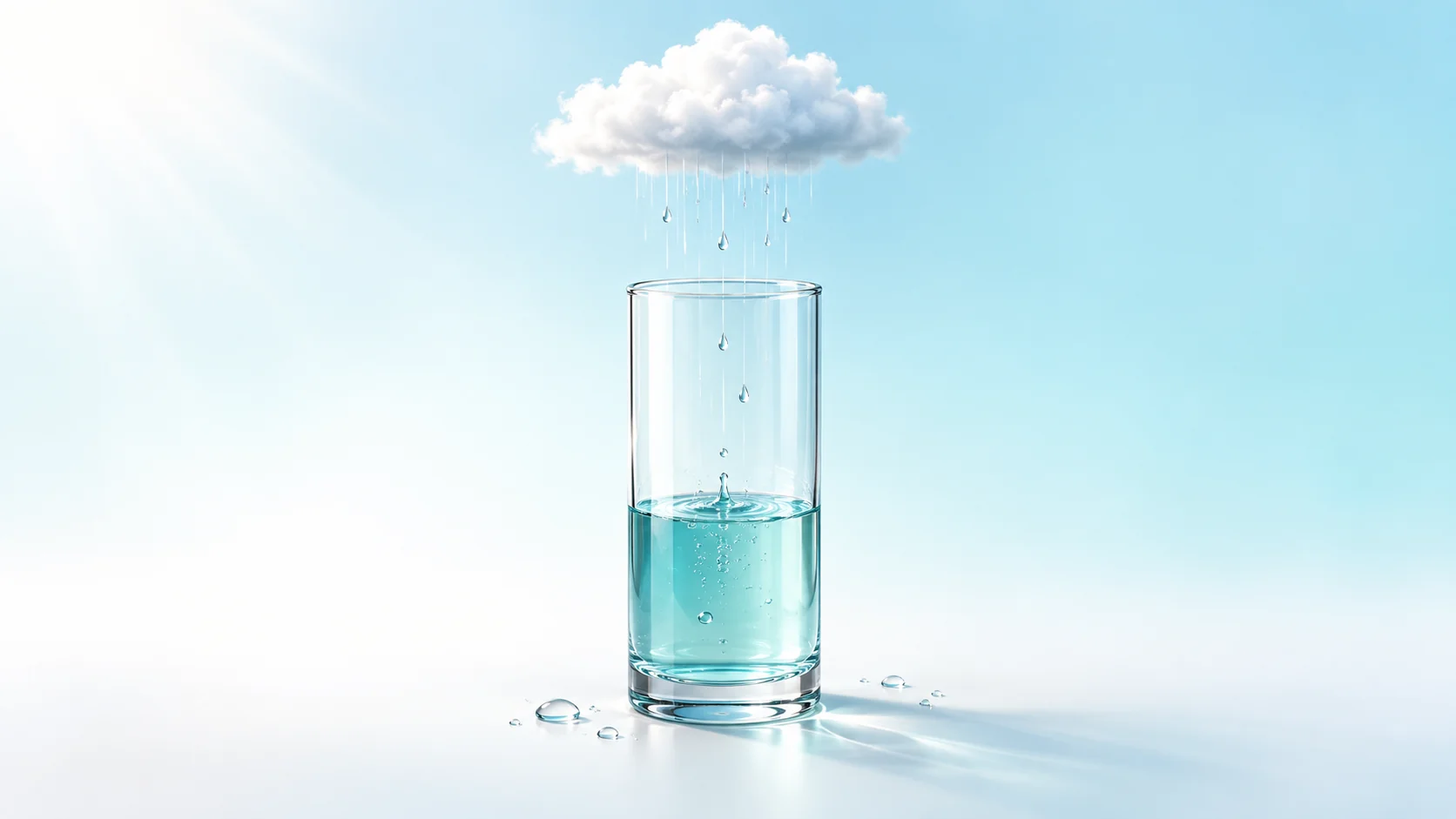
Raindrops, Soaked Clothes and the Chance of a Cold — Becquerel, Gray and Sievert
Bq counts decays per second, Gy is energy absorbed per kilogram, and Sv weights that dose by radiation type (alpha 20, gamma 1) and organ sensitivity, so the same 1 mGy can be 1 mSv or 20 mSv.