Nuclear Theory archive — page 21

Like a City Planner Trimming a Jagged Skyline — What It Means to Flatten the Power Distribution
Power flattening lowers the peaking factor, the ratio of peak to average core power, using burnable poisons, borated water and reload patterns, which buys safety margin against local thermal limits and room to raise average power.

Why the Plants at the Edge of the Garden Grow Slower — Core Power Distribution and the Peaking Factor
Because center fuel burns faster than edge fuel, engineers track the peaking factor, local maximum power divided by average power, to set hot-spot safety margins, monitor the core in real time and plan where fuel goes at each reload.
Turned It Down, So Why Is It Jammed? — How Xenon and Samarium Eat Neutrons
Xenon-135, fed by iodine-135 decay and with a cross-section of about 2.6 million barns, peaks about 8 to 11 hours after power is lowered and can cause slow spatial oscillations, while stable samarium-149 simply accumulates to equilibrium.

Shout "Hello!" in a Canyon — Why a Reflector Changes the Critical Condition
A reflector returns part of the neutrons leaving a core, so the flux falls to zero farther out, and the critical calculation uses an effective radius equal to the actual radius plus the reflector savings, letting a smaller core reach criticality.

Assume a Spherical Cow — Why the Spherical Reactor Keeps Showing Up in Calculations
A spherical core has the smallest surface and buckling for its volume and a flux that is the simple sinc function, with a peaking factor of about 3.29, which is why it serves as the textbook benchmark although commercial reactors are cylindrical.
Slice a Swiss Roll and See the Real Shape — Flux Distribution in a Cylindrical Reactor
In an idealized cylindrical core the flux is J₀(2.405r/Rₑ)·cos(πz/Hₑ), peaking at the center at more than about three times the core average before real plants flatten it.

Why Is a Heating Pad Warmest in the Middle? — The Cosine Flux Curve of a Slab Reactor
In an idealized slab core the neutron flux is exactly φ₀ cos(πx/2aₑ), peaking at the center and falling to zero at the extrapolated boundary, with a peaking factor of π/2, about 1.57.

Start With the Smallest Size That Fits — How a Reactor's Critical Size Is Decided
The critical size is the minimum core dimension at which geometric buckling equals the fixed material buckling; for a sphere the extrapolated radius is π divided by the square root of the material buckling.

The Deal Closes Only When the Specs Match — Geometric Buckling Meets Material Buckling
Geometric buckling is set only by a core's shape and size, material buckling B_m² = (k∞ − 1)/L² only by its composition, and the critical condition B_g² = B_m² is the same as k_eff = 1.
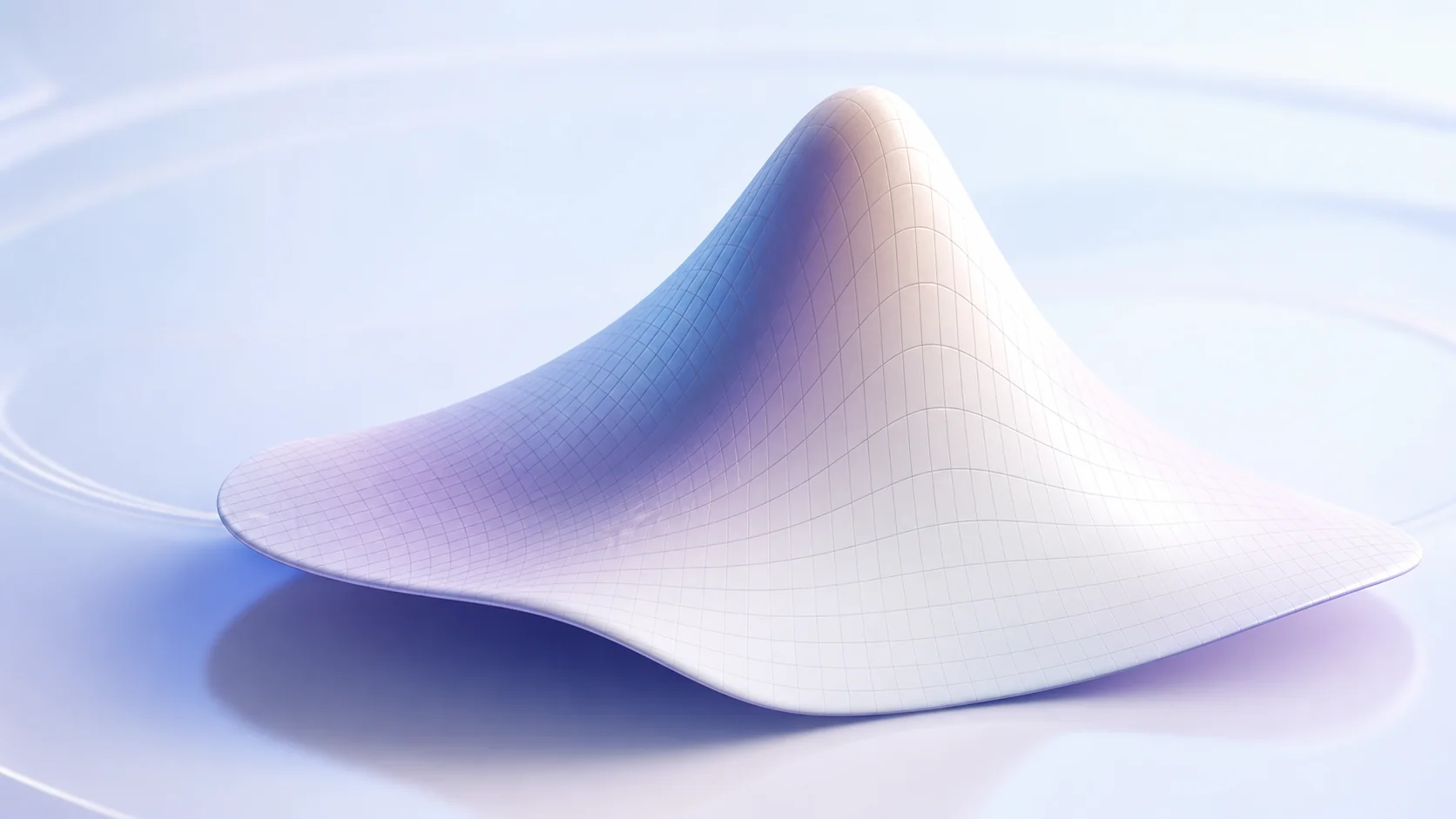
Same Dough, Different Pan — Buckling, the Reactor's Language of Shape
Buckling (B²) is the constant in the steady-state diffusion equation ∇²φ + B²φ = 0 that measures how sharply the neutron flux bends, and it depends on both the core's shape and size and the material inside.