Nuclear History archive — page 28

Scientists in the First World War (Haber and Moseley)
The First World War mobilized science as never before: Fritz Haber directed the 1915 chlorine attack at Ypres, Henry Moseley was killed at Gallipoli aged 27, and James Chadwick spent four years interned at Ruhleben.

Soddy and the Isotope (1913)
In 1913 the displacement law of Fajans and Soddy showed that atoms of different weight can share one place in the periodic table; Soddy named them isotopes in Nature on 4 December 1913, and lead from radioactive minerals confirmed it in 1914.

Moseley and the Atomic Number (1913)
In 1913–1914 Henry Moseley found that X-ray frequencies step up regularly from element to element, proving that the atomic number is the nuclear charge, fixing cobalt at 27 and nickel at 28, and exposing gaps at 43, 61 and 75.

Bohr's Atomic Model (1913)
In 1913 Niels Bohr proposed that electrons occupy only fixed stationary states and emit light when they jump between them, reproducing the Balmer lines of hydrogen and saving Rutherford's nuclear atom.

Rutherford and the Atomic Nucleus (1911)
In 1911 Ernest Rutherford showed that an atom's mass and charge are concentrated in a tiny central charge, predicted the 1/sin⁴(φ/2) scattering law, and saw it confirmed by Geiger and Marsden in 1913.

The Age of the Earth and Radiometric Dating
Kelvin's cooling calculation gave the Earth 20 to 40 million years, but after radioactivity Boltwood (1907) and Holmes (1911–1913) used the lead-to-uranium ratio to date rocks at hundreds of millions to billions of years.

Early Radium Therapy and Radiation Medicine
From Freund's X-ray treatment in 1896 and radium applied to skin lesions in Paris in 1901 to Bell's idea of placing radium inside tumours and the Paris Radium Institute of 1914, radiation became a medical tool once dose and aim were controlled.

The Birth of the Curie (1910)
In September 1910 the Brussels congress named the curie, defined by one gram of radium; the unit was later fixed at 3.7 × 10^10 decays per second (ICRU 1953, CGPM 1964) and joined by the SI becquerel in 1975.
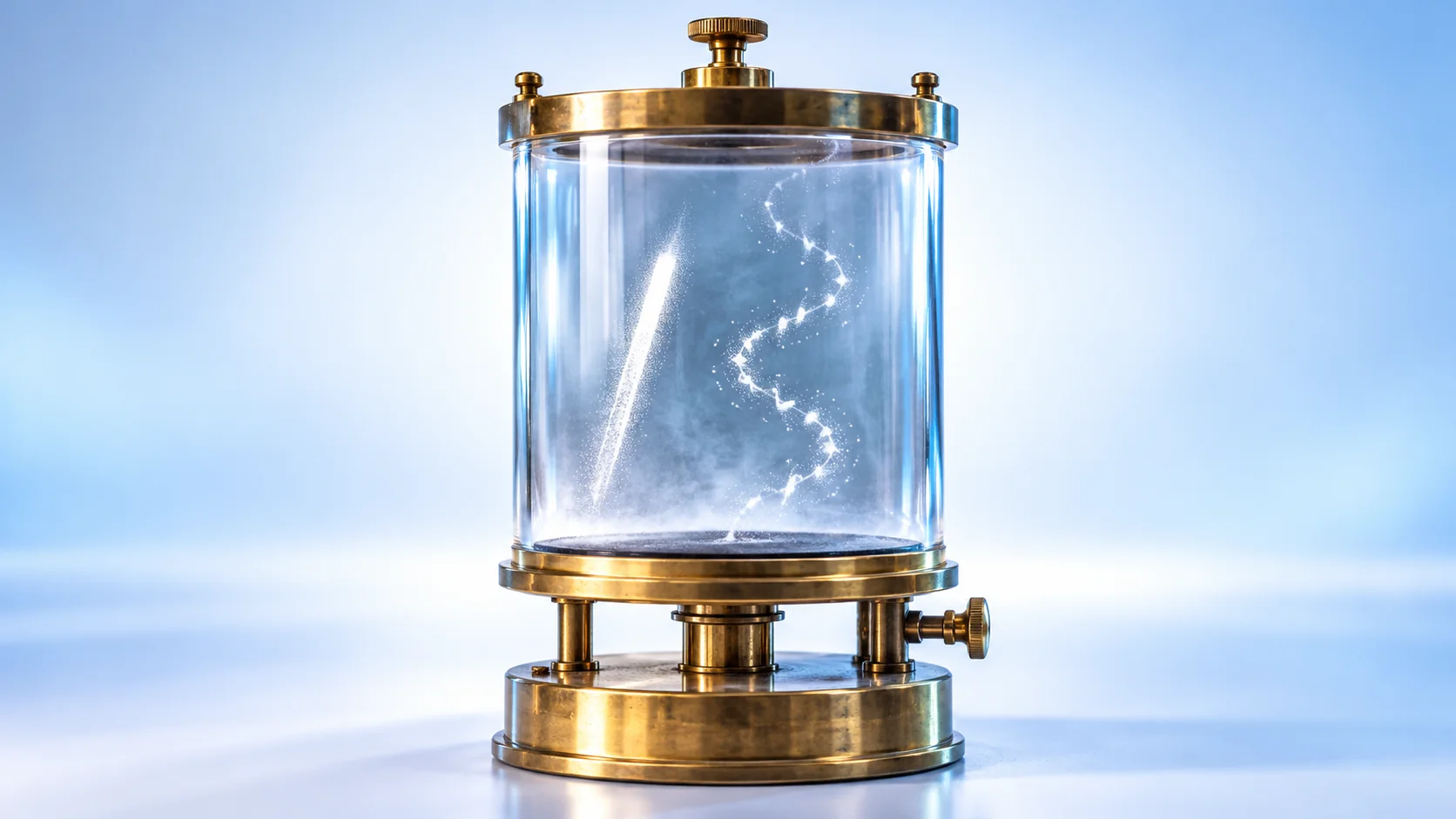
Wilson's Cloud Chamber (1911)
Inspired by coronas and glories on Ben Nevis in 1894, C.T.R. Wilson found that ions seed cloud droplets and in spring 1911 saw the tracks of electrons, alpha and beta particles, creating the cloud chamber that later revealed the positron.

The Geiger–Marsden Experiment (1909)
In 1909 Hans Geiger and Ernest Marsden counted alpha particles turned back by more than 90 degrees from metal reflectors, about 1 in 8,000 for platinum, setting up the discovery of the atomic nucleus.