Nuclear History archive — page 7

The Szilard Petition (1945)
On 17 July 1945, 70 Met Lab scientists signed Leo Szilard's petition asking Truman not to use the atomic bomb unless Japan had seen and refused public surrender terms; it travelled up the chain of command and never reached the President.

The Franck Report (1945)
On 11 June 1945 the Franck Report warned that the atomic secret would last only a few years and urged a demonstration on a desert or barren island; the Scientific Panel and the Interim Committee rejected it by 21 June, and the Soviet Union tested its first bomb in 1949.

Niels Bohr's Plea for an Open World
After escaping Denmark in 1943, Bohr met Churchill (16 May 1944) and Roosevelt (26 August 1944) to urge early international control of the bomb; Hyde Park rejected it, and in 1950 he published his case in an Open Letter to the UN.

Klaus Fuchs and Atomic Espionage
Klaus Fuchs worked on implosion at Los Alamos from August 1944 while spying for the Soviet Union; exposed by Venona, he confessed on 24 January 1950, was sentenced to 14 years, and his statements led to the arrests of Gold, Greenglass and Julius Rosenberg.
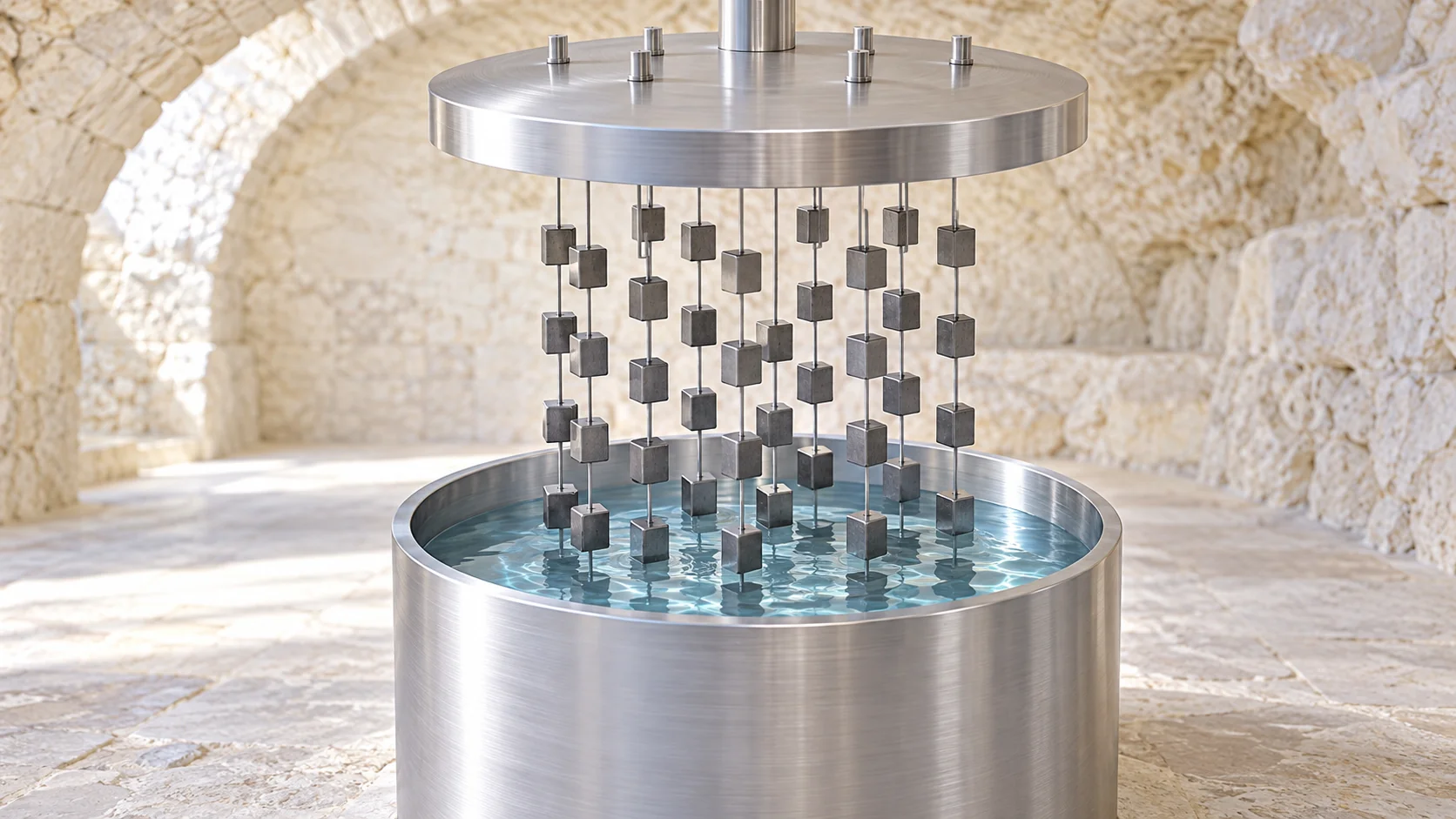
Haigerloch B-VIII: Germany's Unfinished Reactor
In March 1945 the B-VIII pile at Haigerloch, 664 uranium cubes in 1.5 tonnes of heavy water, reached k of about 0.85 before the Alsos Mission dismantled it; the cellar is now the Atomkeller Museum.

The Alsos Mission: Hunting Hitler's Bomb
From Italy in 1943 to Strasbourg in 1944 and Farm Hall in 1945, the Alsos Mission under Boris Pash and Samuel Goudsmit established that the German nuclear programme never got beyond research.

Little Boy and Fat Man: Two Designs (1945)
Little Boy carried about 64 kg of enriched uranium in a gun design of about 15 kt, Fat Man about 6.2 kg of plutonium in an implosion design of about 21 kt, and Project Alberta assembled both on Tinian between 14 July and 9 August 1945.

The Plutonium Crisis and Implosion (1944)
In 1944 Segrè's measurements showed that plutonium-240 made reactor plutonium predetonate in a gun-type bomb; on 17 July the Thin Man design was dropped and Los Alamos turned to implosion.

Oak Ridge's X-10 Graphite Reactor (1943)
X-10, the first reactor designed for continuous operation, went critical at Oak Ridge on 4 November 1943, ran at up to 4 MW, proved the bismuth phosphate process for Hanford, yielded about 320 g of plutonium for research and in 1946 shipped the first reactor-made radioisotope.
Hanford's B Reactor and Xenon Poisoning (1944)
In September 1944 Hanford's B Reactor shut down and restarted by itself; the cause was xenon-135, and extra fuel channels built in as a margin let the plant overcome it.