Nuclear History archive — page 15

de Broglie's Matter Waves (1924)
In November 1924 Louis de Broglie defended a thesis giving every particle a wavelength λ = h/p; Davisson, Germer and G. P. Thomson confirmed electron waves in 1927, and the idea underpins quantum mechanics and reactor neutron physics.

Rutherford Predicts the Neutron (1920)
On 3 June 1920 Ernest Rutherford proposed a neutral particle of mass about 1, a 'neutral doublet' of proton and electron, which James Chadwick finally found as the neutron in 1932.

Eddington's Stellar Energy Hypothesis (1920)
On 24 August 1920 Arthur Eddington argued in Cardiff that gravitational contraction could not power the Sun and that stars must run on sub-atomic energy released as hydrogen becomes helium.

Aston's Mass Spectrograph and the Mass Defect (1919–1922)
In 1919 Francis Aston built the mass spectrograph, established the whole-number rule for isotopes, and measured that helium weighs less than four hydrogen atoms, earning the 1922 Nobel Prize in Chemistry.
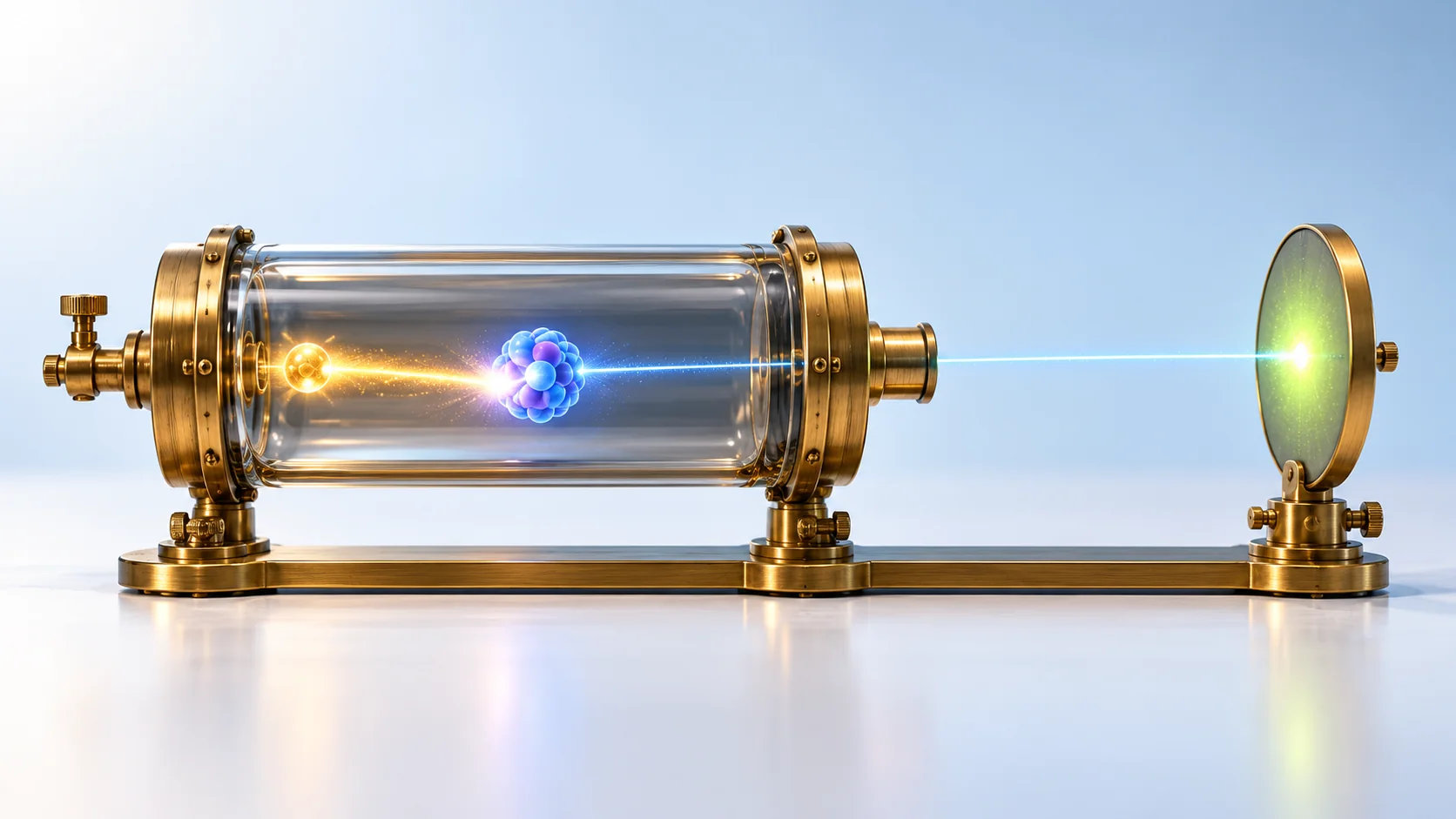
Rutherford's First Artificial Transmutation (1919)
In 1919 Rutherford showed that alpha particles knock hydrogen nuclei out of nitrogen, the first artificial transmutation; in 1925 Blackett's cloud chamber revealed that the nitrogen becomes oxygen-17.

Scientists in the First World War (Haber and Moseley)
The First World War mobilized science as never before: Fritz Haber directed the 1915 chlorine attack at Ypres, Henry Moseley was killed at Gallipoli aged 27, and James Chadwick spent four years interned at Ruhleben.

Soddy and the Isotope (1913)
In 1913 the displacement law of Fajans and Soddy showed that atoms of different weight can share one place in the periodic table; Soddy named them isotopes in Nature on 4 December 1913, and lead from radioactive minerals confirmed it in 1914.

Moseley and the Atomic Number (1913)
In 1913–1914 Henry Moseley found that X-ray frequencies step up regularly from element to element, proving that the atomic number is the nuclear charge, fixing cobalt at 27 and nickel at 28, and exposing gaps at 43, 61 and 75.

Bohr's Atomic Model (1913)
In 1913 Niels Bohr proposed that electrons occupy only fixed stationary states and emit light when they jump between them, reproducing the Balmer lines of hydrogen and saving Rutherford's nuclear atom.

Rutherford and the Atomic Nucleus (1911)
In 1911 Ernest Rutherford showed that an atom's mass and charge are concentrated in a tiny central charge, predicted the 1/sin⁴(φ/2) scattering law, and saw it confirmed by Geiger and Marsden in 1913.