Nuclear History archive — page 27

Dirac's Equation and the Prediction of Antimatter (1928)
Dirac's 1928 equation for the electron yielded negative-energy solutions; after first reading the resulting 'holes' as protons, he predicted the anti-electron in 1931.
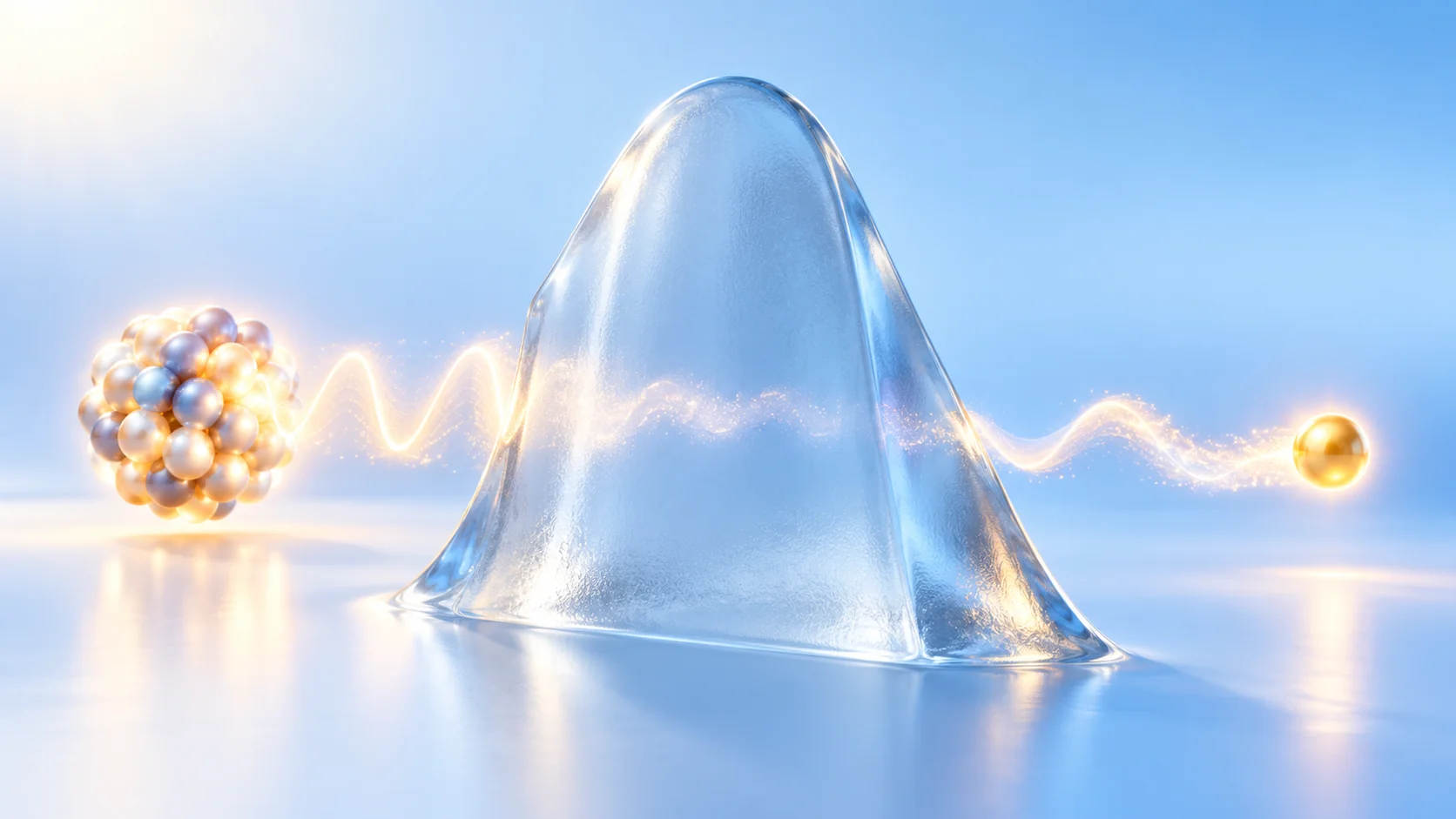
Gamow and Quantum Tunnelling in Alpha Decay (1928)
In summer 1928 George Gamow in Göttingen, and Gurney and Condon at Princeton, explained alpha decay as quantum tunnelling through the Coulomb barrier, also accounting for the Geiger–Nuttall rule.

The Uncertainty Principle and the 1927 Solvay Conference
In 1927 Heisenberg showed that position and momentum cannot both be sharply defined, and at the Fifth Solvay Conference in Brussels Bohr and Einstein argued over what that meant, a year after Einstein's famous 'dice' letter to Born.

Heisenberg, Schrödinger and Quantum Mechanics (1925–1926)
Between June 1925 and June 1926, Heisenberg, Born and Jordan's matrix mechanics and Schrödinger's wave mechanics emerged as rivals, were shown to be equivalent, and gained Born's probability interpretation.

Pauli's Exclusion Principle (1925)
In January 1925 Wolfgang Pauli proposed that no two electrons in an atom can share all four quantum numbers, a rule soon tied to electron spin that explains shell filling, chemistry and the nuclear shell model.

de Broglie's Matter Waves (1924)
In November 1924 Louis de Broglie defended a thesis giving every particle a wavelength λ = h/p; Davisson, Germer and G. P. Thomson confirmed electron waves in 1927, and the idea underpins quantum mechanics and reactor neutron physics.
Rutherford Predicts the Neutron (1920)
On 3 June 1920 Ernest Rutherford proposed a neutral particle of mass about 1, a 'neutral doublet' of proton and electron, which James Chadwick finally found as the neutron in 1932.

Eddington's Stellar Energy Hypothesis (1920)
On 24 August 1920 Arthur Eddington argued in Cardiff that gravitational contraction could not power the Sun and that stars must run on sub-atomic energy released as hydrogen becomes helium.

Aston's Mass Spectrograph and the Mass Defect (1919–1922)
In 1919 Francis Aston built the mass spectrograph, established the whole-number rule for isotopes, and measured that helium weighs less than four hydrogen atoms, earning the 1922 Nobel Prize in Chemistry.
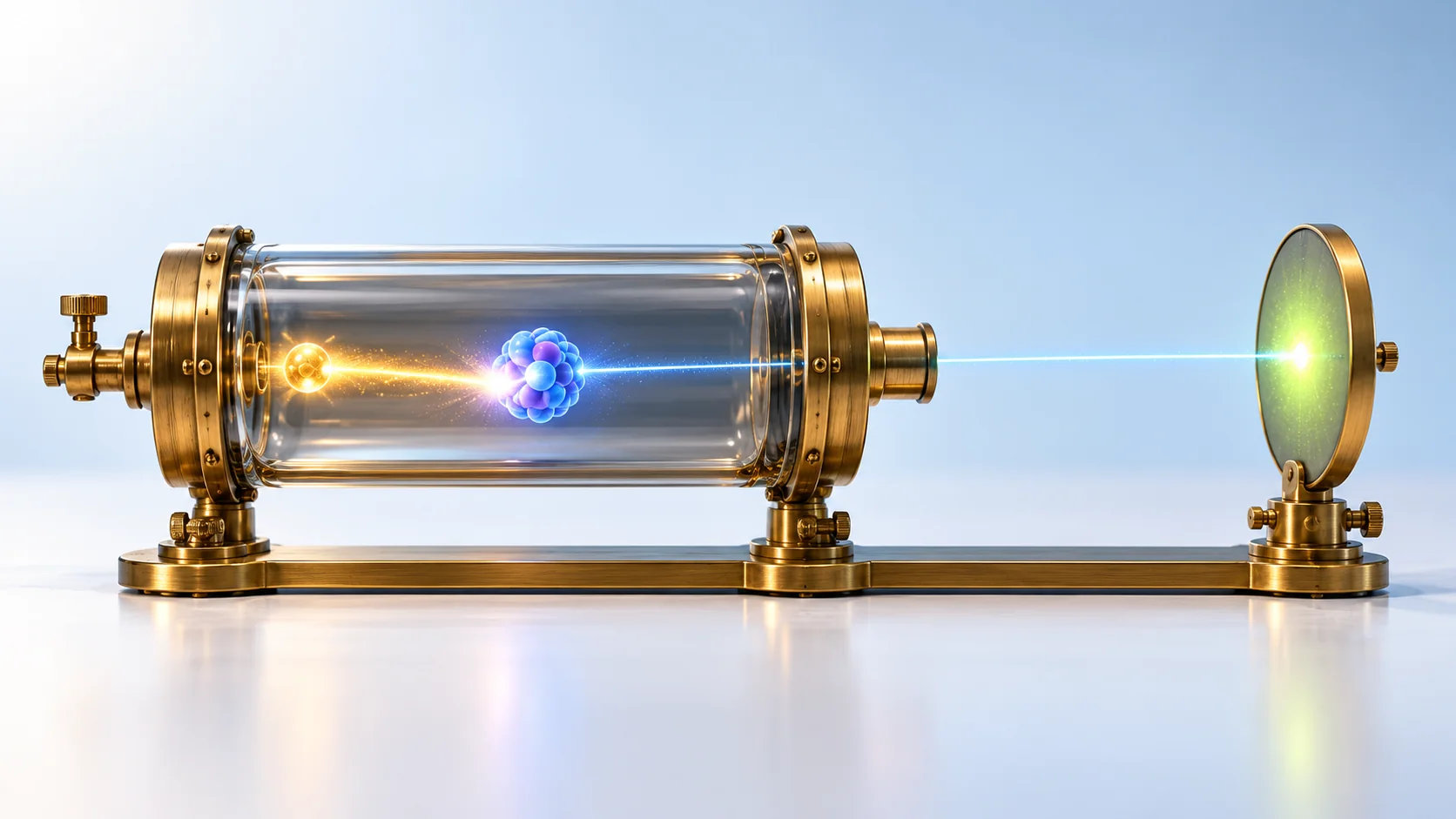
Rutherford's First Artificial Transmutation (1919)
In 1919 Rutherford showed that alpha particles knock hydrogen nuclei out of nitrogen, the first artificial transmutation; in 1925 Blackett's cloud chamber revealed that the nitrogen becomes oxygen-17.