Waste, Fuel Cycle & Decommissioning · C-WD-006
Pyroprocessing — Dry Processing That Recovers Uranium and Transuranics Together by Molten-Salt Electrochemistry
Electrolytic reduction, electrorefining and electrowinning in molten salt at 500–650 °C recover U and a U/TRU mixture, intended to be burned in a sodium-cooled fast reactor.
Pyroprocessing is a technology that treats spent nuclear fuel electrochemically in molten salts (LiCl–Li₂O, LiCl–KCl) at 500–650 °C. It recovers uranium (U) and the transuranic elements (TRU) as groups, and divides the fission products into salt and metal waste streams according to their chemistry. In contrast with aqueous reprocessing (PUREX), which uses water and organic solvents, it is also called "dry reprocessing".
In short, pyroprocessing is a dry process that treats spent fuel in a high-temperature molten-salt medium by electrolytic reduction, electrorefining and electrowinning to recover U and a U/TRU mixture, aimed at reducing high-level waste in combination with a sodium-cooled fast reactor (SFR).
Principle and mechanism
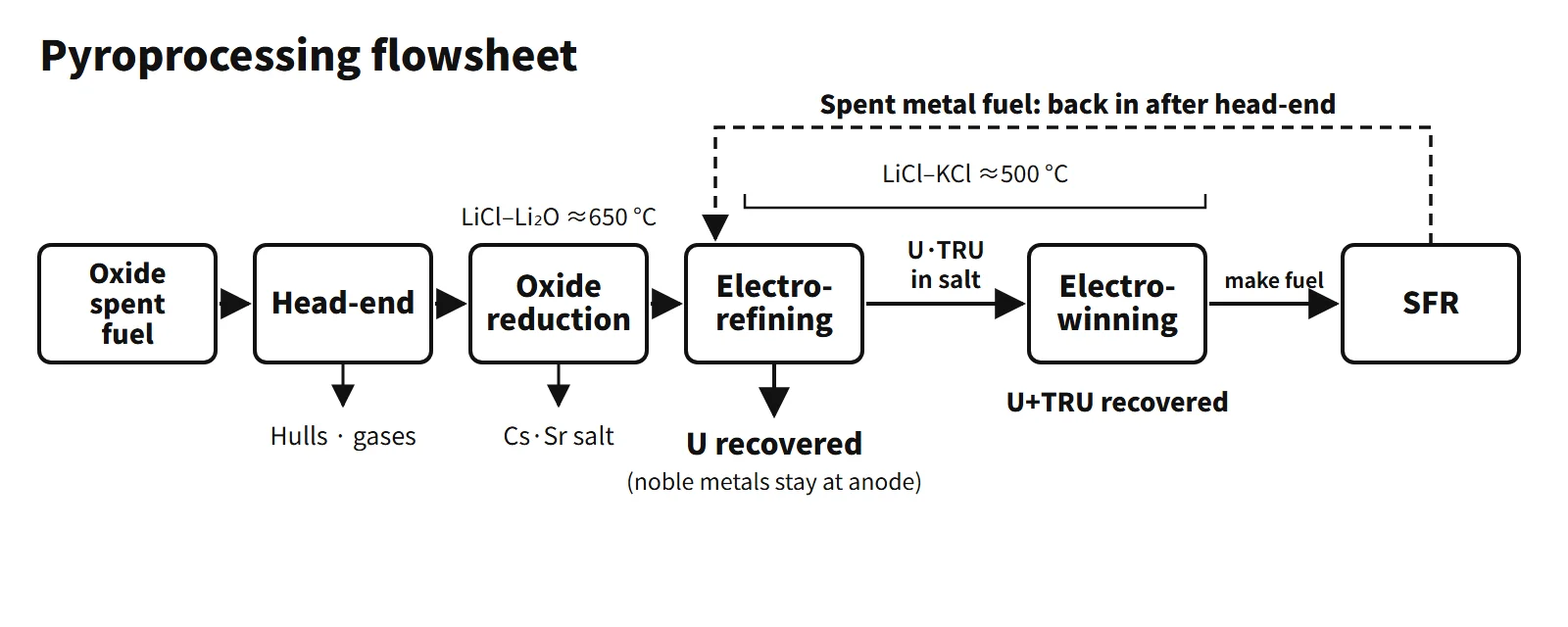
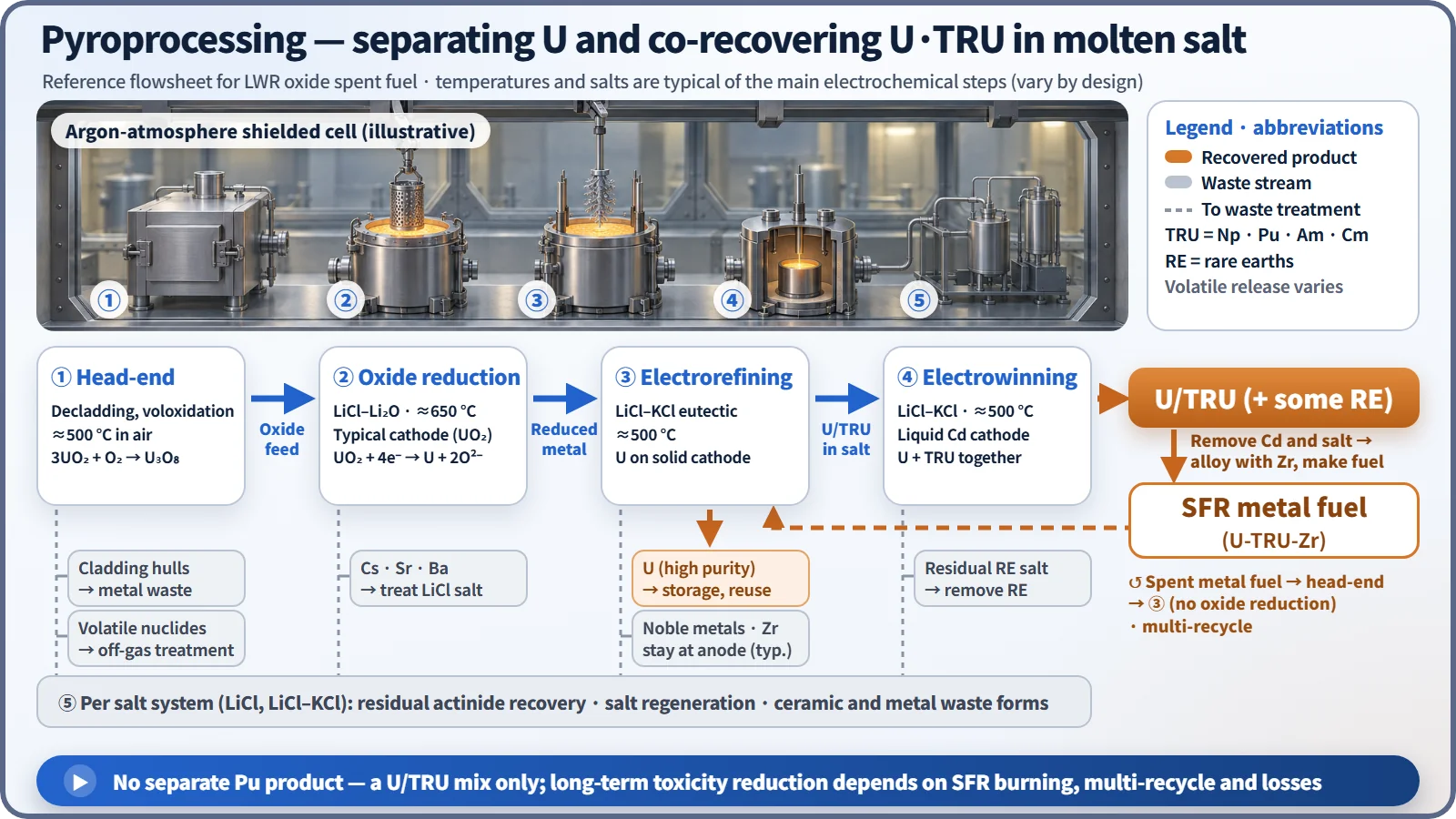
Process flow — five steps
Argonne National Laboratory (ANL) developed the process for metallic fuel in the Integral Fast Reactor (IFR) program and applied it to the treatment of EBR-II spent fuel. Light-water reactor fuel is an oxide (UO₂), so an electrolytic reduction step was added at the front to convert it to metal.
- Head-end: the fuel is disassembled, cut and decladded. High-temperature oxidation in air at about 500 °C (voloxidation) turns UO₂ into U₃O₈ powder, and volatile nuclides such as H-3, C-14, Kr, Xe and I are captured in the off-gas treatment system. Release fractions vary with conditions.
- Electrolytic (oxide) reduction: in LiCl–Li₂O (about 1 wt%) molten salt at about 650 °C, the oxide is reduced to metal. The representative cathode reaction for UO₂ is UO₂ + 4e⁻ → U + 2O²⁻, and oxygen is evolved at the anode. Salt adhering to the reduced product is removed before the next step. Cs, Sr and Ba dissolve into the salt.
- Electrorefining: in LiCl–KCl eutectic salt at about 500 °C, the reduced metal is placed in an anode basket and dissolved. Only U deposits selectively on the solid (steel) cathode; under representative conditions the noble metals remain at the anode and become metal waste.
- Electrowinning: from the salt in which U and TRU have accumulated after refining, a liquid cadmium cathode (LCC) recovers U and TRU (Np, Pu, Am, Cm) together. The anode is an inert carbon anode; chlorine is evolved and recovered. Some rare earths (RE) come along.
- Residual actinide recovery, salt regeneration and solidification: the LiCl-based and LiCl–KCl salts are purified separately for reuse; Cs, Sr and RE wastes are made into ceramic waste forms, and cladding hulls and anode residues into metal waste forms.
Why the elements separate — chloride stability
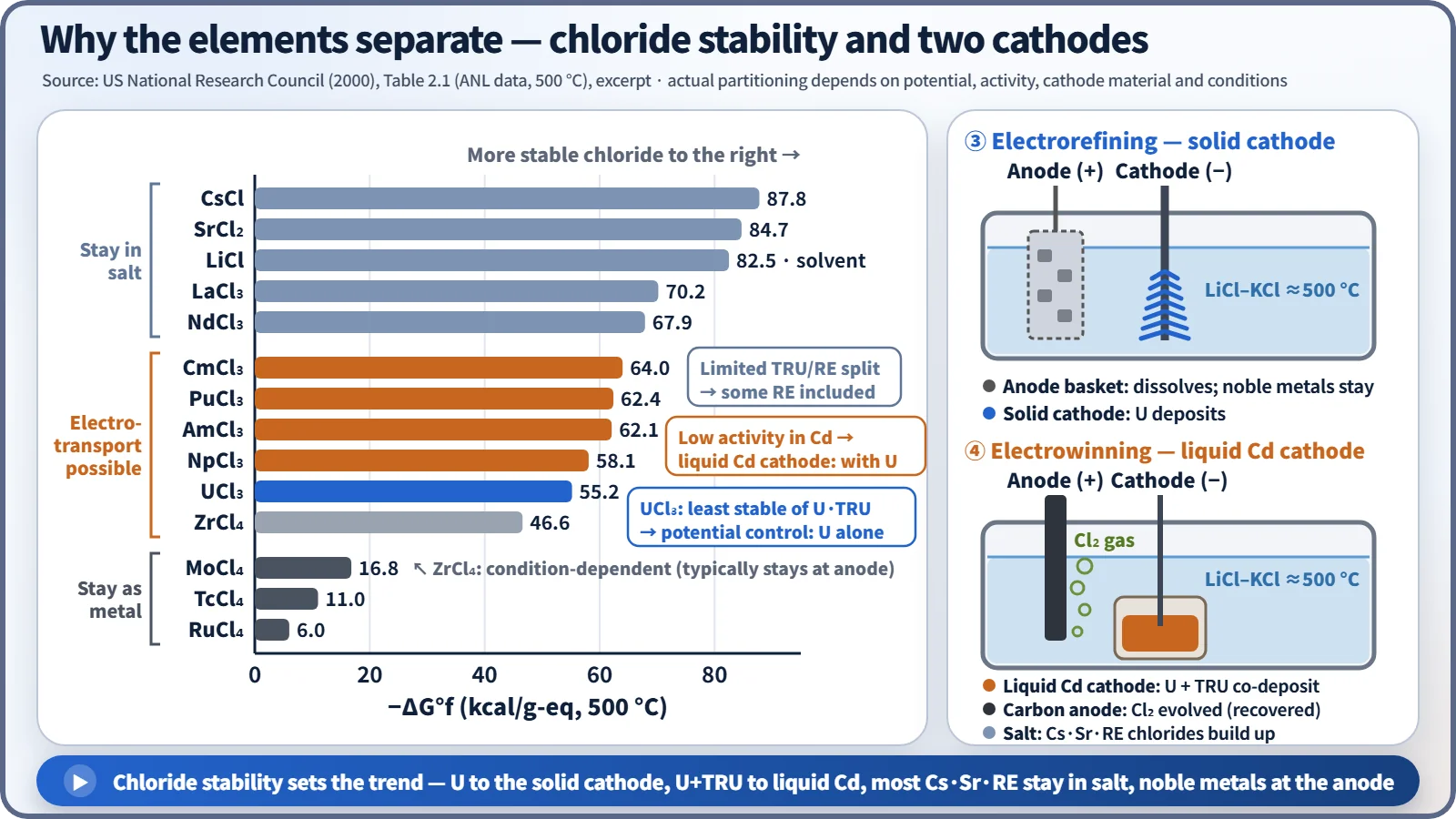
The basic tendency of the separation is set by the free energy of chloride formation (−ΔG°, kcal/g-equivalent, 500 °C). The values from Table 2.1 of the US National Research Council (NRC, 2000) report (ANL data) are:
- Stay in the salt: CsCl 87.8, SrCl₂ 84.7, LaCl₃ 70.2, NdCl₃ 67.9
- Can be electrotransported: CmCl₃ 64.0, PuCl₃ 62.4, AmCl₃ 62.1, NpCl₃ 58.1, UCl₃ 55.2, ZrCl₄ 46.6
- Stay as metal: MoCl₄ 16.8, TcCl₄ 11.0, RuCl₄ 6.0
Among U and the TRU, UCl₃ is the least stable, so with potential control U deposits selectively on the solid cathode. ZrCl₄ is even less stable, but under operating conditions that suppress Zr dissolution it stays at the anode. The activity of TRU in liquid cadmium is greatly lowered, so TRU deposit together with U. Selectivity between TRU and RE is limited, so some RE ends up in the product. Actual partitioning also depends on electrode potential, activity, cathode material and operating conditions.
What it means in a plant — the SFR link and the waste-reduction claim
Pyroprocessing is only separation; it does not destroy TRU. The U/TRU mixture has to be made into U-TRU-Zr metallic fuel and burned in an SFR, because the fraction of TRU that fissions is high in a fast neutron spectrum. Spent SFR metallic fuel returns to electrorefining without electrolytic reduction, closing a multi-recycle loop.
Repository area is governed by decay heat. For the first few decades Cs-137 and Sr-90 are the main heat sources; in the long term Am-241 and Pu. The waste-reduction argument is that removing Cs and Sr for separate decay storage and transmuting the TRU reduces the disposal burden.
- Claimed benefit (assuming SFR multi-recycle): proponents claim large reductions in high-level waste disposal volume, repository area and the time needed for radiotoxicity to fall to the natural-uranium level; the factors quoted depend strongly on the scenario and the basis of comparison.
- Criticism: several high-level waste streams all require deep geological disposal, and the combined volume of the waste forms could exceed that of the original spent fuel (Bulletin of the Atomic Scientists article, 2017). Even in process developers' own analyses, after about 300 years the U/TRU/RE products account for most of the decay heat and toxicity. The reduction holds only if the TRU are actually burned.
Proliferation resistance — two views
| View | Arguments |
|---|---|
| Resistance is high (proponents) | No separate Pu product (U/TRU/RE mixture); the product is more radioactive and hotter than PUREX Pu; remote operation in shielded cells; safeguards built in at the design stage |
| The benefit is limited | A joint study by US national laboratories (Bari et al., 2009) judged the risk reduction relative to PUREX to be modest and relevant mainly to non-state actors; a state diverting material could purify it further; the product's radiation is far lower than that of spent fuel, so self-protection is weak |
The IAEA treats any processing facility as subject to safeguards, regardless of the technology. A particular challenge is that nuclear material is dispersed and held up in the molten-salt and metal phases, which makes accountancy difficult. Proliferation resistance is a concept that evaluates intrinsic features together with extrinsic measures (safeguards, physical protection) (IAEA INPRO and GIF PR&PP methodologies). An objective assessment presents both views.
Regulatory and design criteria
- IAEA: comprehensive safeguards (INFCIRC/153), Additional Protocol (INFCIRC/540), safety of nuclear fuel cycle facilities SSR-4 (2017).
- Supplier consent: reprocessing of material from some supplier states requires that state's consent. For example, the US Nuclear Non-Proliferation Act (NNPA, 1978) requires US consent for reprocessing by partner countries.
Easily confused pairs
| Item | PUREX (aqueous) | UREX+ (aqueous variant) | Pyroprocessing (dry) |
|---|---|---|---|
| Medium | Nitric acid + 30 % TBP solvent extraction | Nitric acid + TBP, with AHA suppressing Pu and Np extraction → extract U only, then separate Tc, Cs/Sr and TRU | Molten salt, electrochemistry |
| Products | Pure U, pure Pu | U, TRU group (by variant) | U, U/TRU mixture |
| Maturity | Commercial (La Hague and others) | Laboratory scale | Engineering-scale demonstration |
| Link | LWR MOX | Fast and transmutation reactors | SFR metallic fuel |
| Proliferation view | Pure Pu is the main issue | Designed not to separate Pu alone | Pu not separated alone; degree of benefit disputed |
| Weakness | Large volumes of liquid waste | Complex process | Recovery and purity, salt waste, accountancy |
Do not assert that pyroprocessing "is not reprocessing": the US government regards it as a form of reprocessing.
Key points at a glance
- Definition: dry processing that treats spent fuel electrochemically in high-temperature molten salt and recovers U and U/TRU as groups.
- Process: head-end (decladding, voloxidation) → electrolytic reduction (LiCl–Li₂O, about 650 °C) → electrorefining (LiCl–KCl, about 500 °C, U on a solid cathode) → electrowinning (liquid Cd cathode, U + TRU) → salt regeneration and solidification.
- Principle: differences in chloride formation free energy — most Cs, Sr and RE stay in the salt, noble metals at the anode, U on the solid cathode, U + TRU in the liquid Cd cathode.
- Advantages: no separate Pu; no water or organic solvent, so radiation resistance is high and criticality constraints are eased; small modular units; directly linked to SFR metallic fuel.
- Waste: with SFR multi-recycle, claimed reductions in repository area and in the duration of radiotoxicity (scenario-dependent).
- Challenges: recovery and purity, salt waste treatment, nuclear material accountancy, economics, and, where applicable, supplier-state consent for reprocessing (for example under the US NNPA).