Reactor Physics & Kinetics · C-RX-005
Material and Geometric Buckling — Critical When the Curvature the Materials Can Sustain Equals the Curvature the Shape Demands
The materials set how much flux curvature they can sustain, the shape sets how much it needs; the core is critical where the two meet.
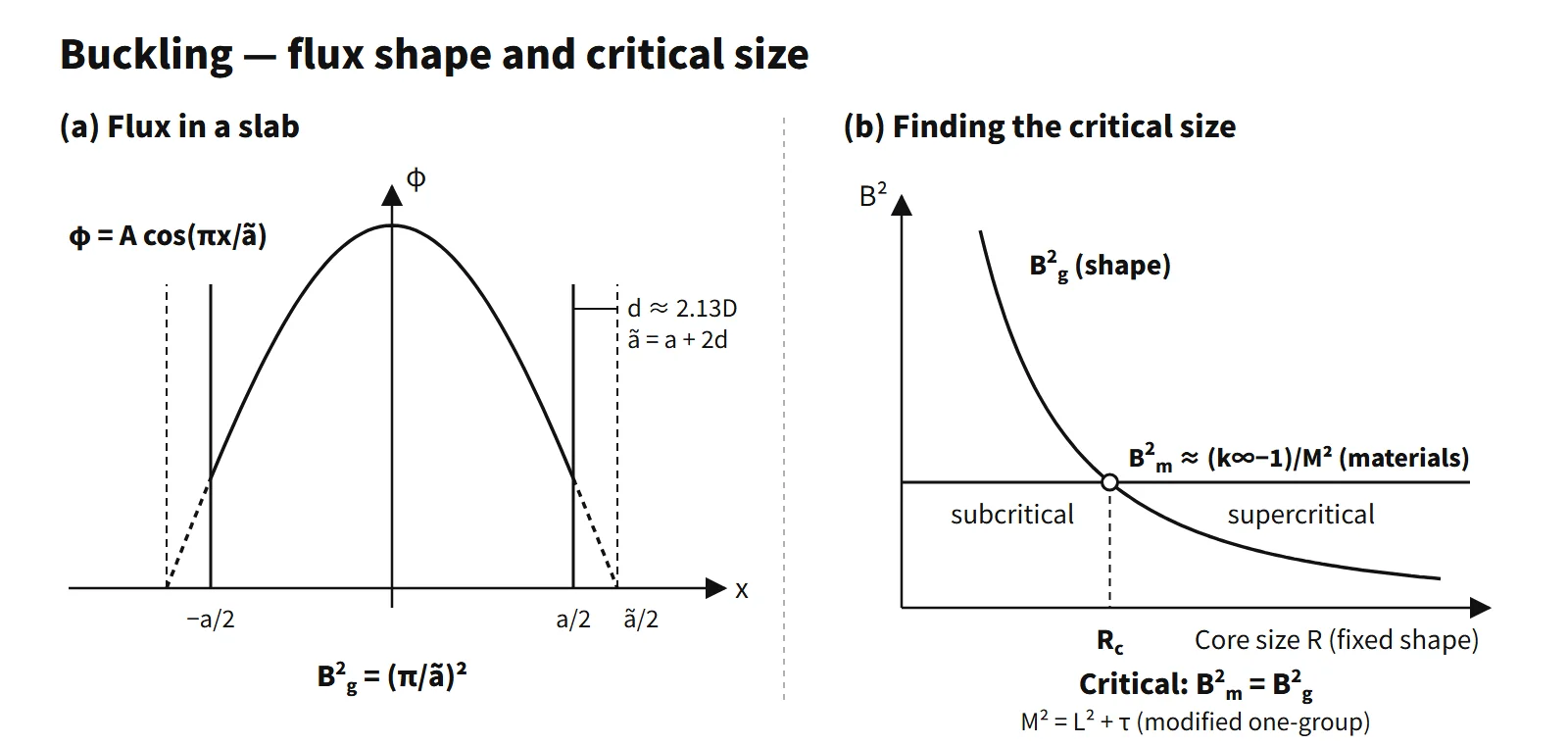
Buckling (B²) is the constant obtained when the one-group diffusion equation is written as ∇²φ + B²φ = 0; it is the relative curvature of the flux distribution (−∇²φ/φ). The value set by the material composition alone is the material buckling Bm² = (k∞ − 1)/L² (M² in modified one-group theory), and the value set by core shape, dimensions and boundary conditions is the geometric buckling Bg². The core is critical when the two are equal.
In short: buckling is the eigenvalue of the diffusion equation that expresses the curvature of the flux; the core is critical when the Bm² allowed by the materials equals the Bg² required by the shape. It shares only its name with buckling in structural mechanics.
Principle and mechanism
Two viewpoints — physics (materials) and mathematics (shape)
D∇²φ − Σaφ + (1/k)·νΣfφ = 0
- Physical viewpoint (material buckling): at criticality (k = 1) the equation becomes ∇²φ + [(νΣf − Σa)/D]φ = 0. The bracket is Bm², and with k∞ = νΣf/Σa and L² = D/Σa, Bm² = (k∞ − 1)/L². It says how much the flux must curve for the net production per unit volume, (νΣf − Σa)φ, to leave exactly as leakage, −D∇²φ. Think of it as the curvature the materials "can sustain".
- Mathematical viewpoint (geometric buckling): the same equation must satisfy φ = 0 at the (extrapolated) boundary. Solutions satisfying this condition exist only when B² takes particular eigenvalues, and the fundamental mode, with φ > 0 everywhere, corresponds to the smallest eigenvalue Bg². It is the curvature the shape "demands", independent of the materials.
The judgement is simple: Bm² = Bg² means critical, Bm² > Bg² supercritical, and Bm² < Bg² subcritical. If k∞ < 1, then Bm² < 0 and no size can make the core critical.
Relation to keff and the non-leakage probabilities
Away from criticality, keeping 1/k in the equation gives keff = k∞/(1 + L²Bg²), in which the thermal non-leakage probability PTNL = 1/(1 + L²Bg²) appears directly. Including the fast group:
- Modified one-group: keff ≈ k∞/(1 + M²Bg²), M² = L² + τ
- Age-diffusion: keff = k∞·e−τBg²/(1 + L²Bg²), fast non-leakage probability PFNL = e−τBg² (two-group approximation 1/(1 + τBg²))
As the core gets larger, Bg² gets smaller and both non-leakage probabilities approach 1. The Fermi age τ is one sixth of the mean square distance a fast neutron travels while slowing down to thermal energy. From the Lamarsh tables, light water has τ ≈ 27 cm² and L² = 8.1 cm², heavy water 131 cm² and 9.4×10³ cm², and graphite 368 cm² and 3,500 cm². In light-water reactors τ is larger than L², so a one-group calculation that leaves out fast leakage is badly wrong.
Geometric buckling by shape
Dimensions are measured to the extrapolated boundary. The extrapolation distance is d ≈ 0.71λtr = 2.13D and can be neglected in large reactors.
| Shape | Bg² | Flux distribution | φmax/φavg |
|---|---|---|---|
| Slab (thickness a) | (π/a)² | A cos(πx/a) | 1.57 |
| Rectangular box a×b×c | (π/a)² + (π/b)² + (π/c)² | cos·cos·cos | 3.88 |
| Finite cylinder (R, H) | (2.405/R)² + (π/H)² | A J₀(2.405r/R)cos(πz/H) | 3.64 |
| Sphere (radius R) | (π/R)² | A sin(πr/R)/r | 3.29 |
2.405 is the first zero of J₀. For the slab the symmetry condition φ(−x) = φ(x) removes the sine term, and φ(X₀/2) = 0 gives B = π/X₀ and φ = A cos(πx/X₀). For the sphere, normalizing to the power P = ERΣf∫φdV gives φ(r) = [P/(4R²ERΣf)]·sin(πr/R)/r.
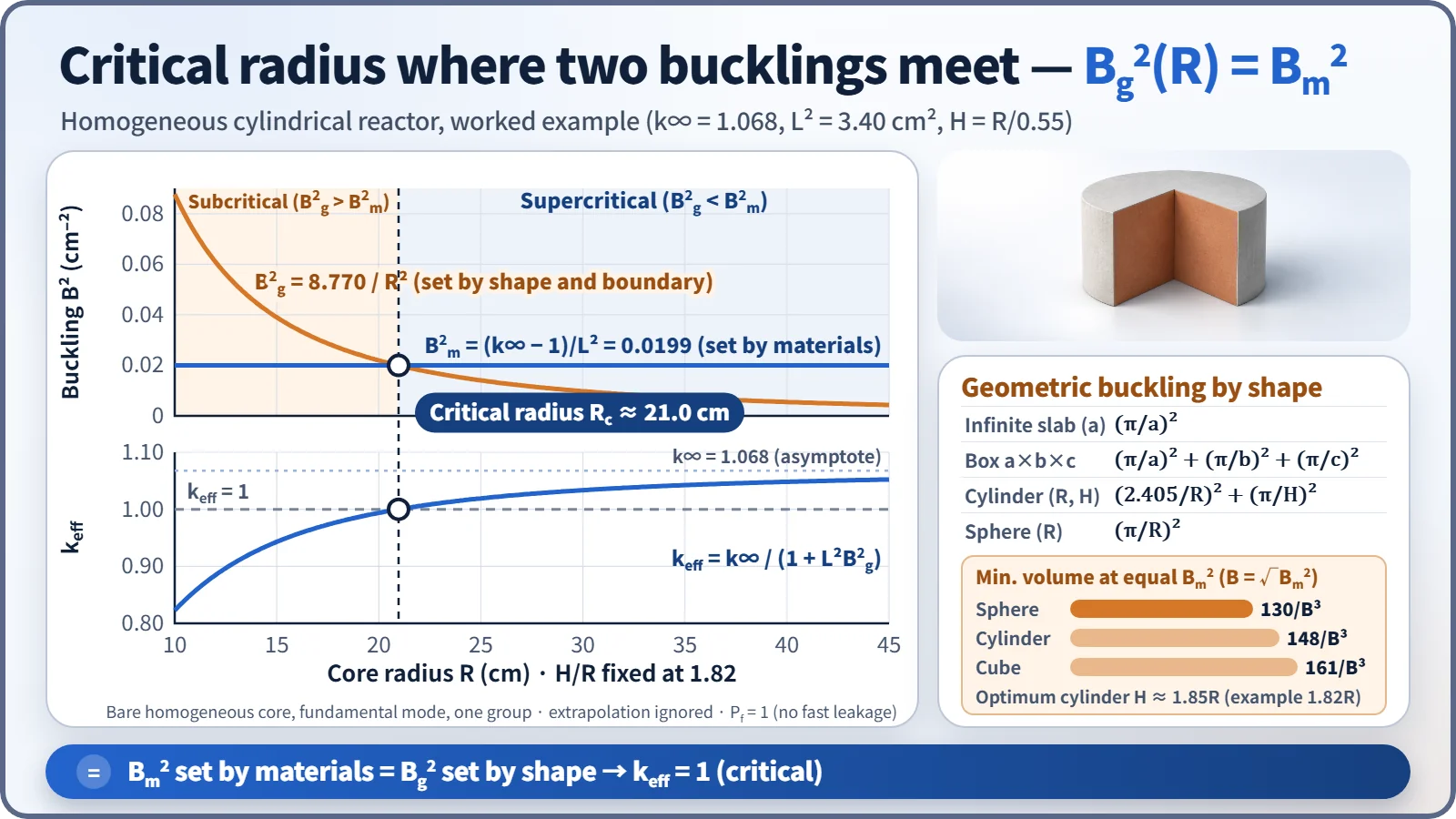
For the same Bm², the shape with the smallest volume is the sphere (V ≈ 130/B³); the optimum cylinder, with H ≈ 1.85R (H/D ≈ 0.92), has V ≈ 148/B³, and a cube 161/B³. The Lamarsh example rounds the optimum cylinder to H = 1.82R. The larger the volume relative to the surface area, the smaller the leakage and the smaller the critical mass.
Procedure for critical radius and critical mass
Critical-size calculations follow four steps: ① composition → k∞ and L² (M²); ② Bm² = (k∞ − 1)/M²; ③ set the shape formula Bg²(dimensions) equal to Bm² to get the dimensions; ④ volume × fuel fraction × density = mass.
Example 1 — critical radius of a homogeneous cylindrical reactor: with ε = Pf = p = 1, ν = 2.43, σaH₂O = 0.664 b, σaUO₂ = 23 b, σf²³⁵ = 580 b and Lth² = 8.1 cm².
- f = 4×23/(4×23 + 100×0.664) = 0.581
- η = 2.43×(0.03×580)/23 = 1.838 → k∞ = ηf = 1.068
- Homogeneous mixture L² = LM²(1 − f) = 8.1×0.419 = 3.40 cm²
- Bm² = 0.0677/3.40 = 0.0199 cm⁻²
- Since H = R/0.55, Bg² = [2.405² + (0.55π)²]/R² = 8.770/R² → R ≈ 21.0 cm (H ≈ 38.1 cm)
This value results from removing fast leakage by setting Pf = 1. With real light-water moderation, M² = 3.40 + 27 ≈ 30 cm² and R ≈ 63 cm.
Example 2 — critical mass of natural uranium in a heavy-water reactor: with Bm² = 8.6 m⁻² (1 m⁻² = 10⁻⁴ cm⁻²).
- Bm² = 8.6×10⁻⁴ cm⁻², H = 2.4R → Bg² = [2.405² + (π/2.4)²]/R² = 7.497/R²
- R = 93.4 cm, H = 224 cm, V = πR²H = 6.14×10⁶ cm³
- Fuel volume fraction = π(1.27)²/(15.2)² = 0.0219 → fuel 1.35×10⁵ cm³
- Mass = 19 g/cm³ × 1.35×10⁵ cm³ ≈ 2.56 t (extrapolation distance ignored, fuel rods assumed to run the full height)
What it means in a plant
- Design: large PWR cores have a small Bg², so leakage is only a few percent. The k∞ margin (excess reactivity) is offset with boron, control rods and burnable poisons. Because the core's Bg² is fixed, reactivity changes during operation can be read as changes in Bm² (k∞, M²) with moderator temperature and boron concentration.
- Power distribution: φmax/φavg = 3.64 for a bare cylinder is the starting point for peaking factors. Real cores flatten the distribution with a reflector (which reduces the critical dimensions by the reflector savings δ), low-leakage loading patterns and burnable poisons.
- Criticality safety: in fuel storage and handling, keff < 1 is secured by making Bg² large (thin slabs, slender cylinders, maintained rack spacing). This is "geometry control", the physical basis for storage rack pitch and neutron absorber panel design.
Regulatory and design criteria
The criteria below are examples from the United States (US NRC, ANSI/ANS) and the IAEA.
- 10 CFR 50.68 (introduced 1998): new fuel storage keff ≤ 0.95 (flooded with unborated water) and ≤ 0.98 under optimum moderation; spent fuel storage keff ≤ 0.95 (< 1.0 with unborated water if credit is taken for soluble boron); all at 95/95.
- GDC 62: requires criticality in fuel storage and handling to be prevented, preferably by geometrically safe configurations.
- NUREG-0800 SRP 4.3, 9.1.1 and 9.1.2: review core criticality and power distribution calculation methods and storage criticality analyses.
- ANSI/ANS-8.1: sets single-parameter subcritical limits such as sphere diameter, cylinder diameter and slab thickness.
- IAEA SSG-27 (Rev. 1, 2022): guidance on criticality safety in the handling of fissile material. Systems that are intentionally critical, such as reactor cores, are excluded; core design requirements are in SSR-2/1 (Rev. 1, 2016).
- Then versus now: the physics of buckling has not changed. IAEA SSG-27 was first issued in 2014 and revised as Rev. 1 in 2022.
Easily confused pairs
| Material buckling Bm² | Geometric buckling Bg² | |
|---|---|---|
| Determined by | Composition, enrichment, moderator ratio, temperature, boron | Shape, dimensions, extrapolation distance |
| Expression | (k∞ − 1)/L², (k∞ − 1)/M² | Smallest eigenvalue of the Helmholtz equation |
| Viewpoint | Physics (production − absorption = leakage) | Mathematics (solution satisfying the boundary condition) |
| When it increases | Reactivity increases | Leakage increases (the core is smaller) |
| L² (thermal diffusion area) | τ (Fermi age) | |
|---|---|---|
| Applies to | Thermal neutrons, until absorption | Fast → thermal, during slowing down |
| Meaning | One sixth of the mean square distance travelled | One sixth of the mean square distance while slowing down |
| Non-leakage | 1/(1 + L²B²) | e−τB² |
Key points at a glance
- Definition: the constant of the diffusion equation ∇²φ + B²φ = 0; the flux curvature −∇²φ/φ.
- Material buckling: Bm² = (νΣf − Σa)/D = (k∞ − 1)/L² (modified one-group M² = L² + τ); a function of composition only.
- Geometric buckling: the smallest eigenvalue satisfying φ = 0 at the extrapolated boundary; a function of shape and dimensions only.
- By shape: slab (π/a)², cylinder (2.405/R)² + (π/H)², sphere (π/R)².
- Criticality condition: Bm² = Bg² critical, Bm² > Bg² supercritical, Bm² < Bg² subcritical.
- keff: keff = k∞/(1 + M²Bg²), PTNL = 1/(1 + L²Bg²), PFNL = e−τBg².
- Critical dimensions: found from Bg²(dimensions) = Bm²; for the same Bm² the sphere has the smallest volume (130/B³).
- Uses: sizing the core, reducing critical dimensions with a reflector, geometry control in storage and handling.
- Common pitfalls: watch the units (1 m⁻² = 10⁻⁴ cm⁻²), state which L² or M² is used, and note when an assumption such as Pf = 1 removes fast leakage.