Operation, Regulation & Quality · C-OP-008
Nuclear Quality Assurance (QA) — The 18 Criteria of 10 CFR 50 App. B, NQA-1, CFSI and Commercial-Grade Dedication
More than inspection: independence, objective evidence and a graded approach, and why a test certificate still needs its own authenticity check.
Nuclear quality assurance (QA) comprises all the planned and systematic actions necessary to provide adequate confidence that safety-related structures, systems and components (SSCs) will perform satisfactorily in service. In the United States, for example, it is required through the 18 criteria of 10 CFR 50 App. B; internationally, IAEA GSR Part 2 sets the management-system requirements.
Quality control (QC) — checking that the physical characteristics of an item meet requirements — is part of QA. QA is not inspection alone but a management system that ties together organization, design, procurement, records and audits.
Principle and mechanism
The 18 criteria follow an item through its life
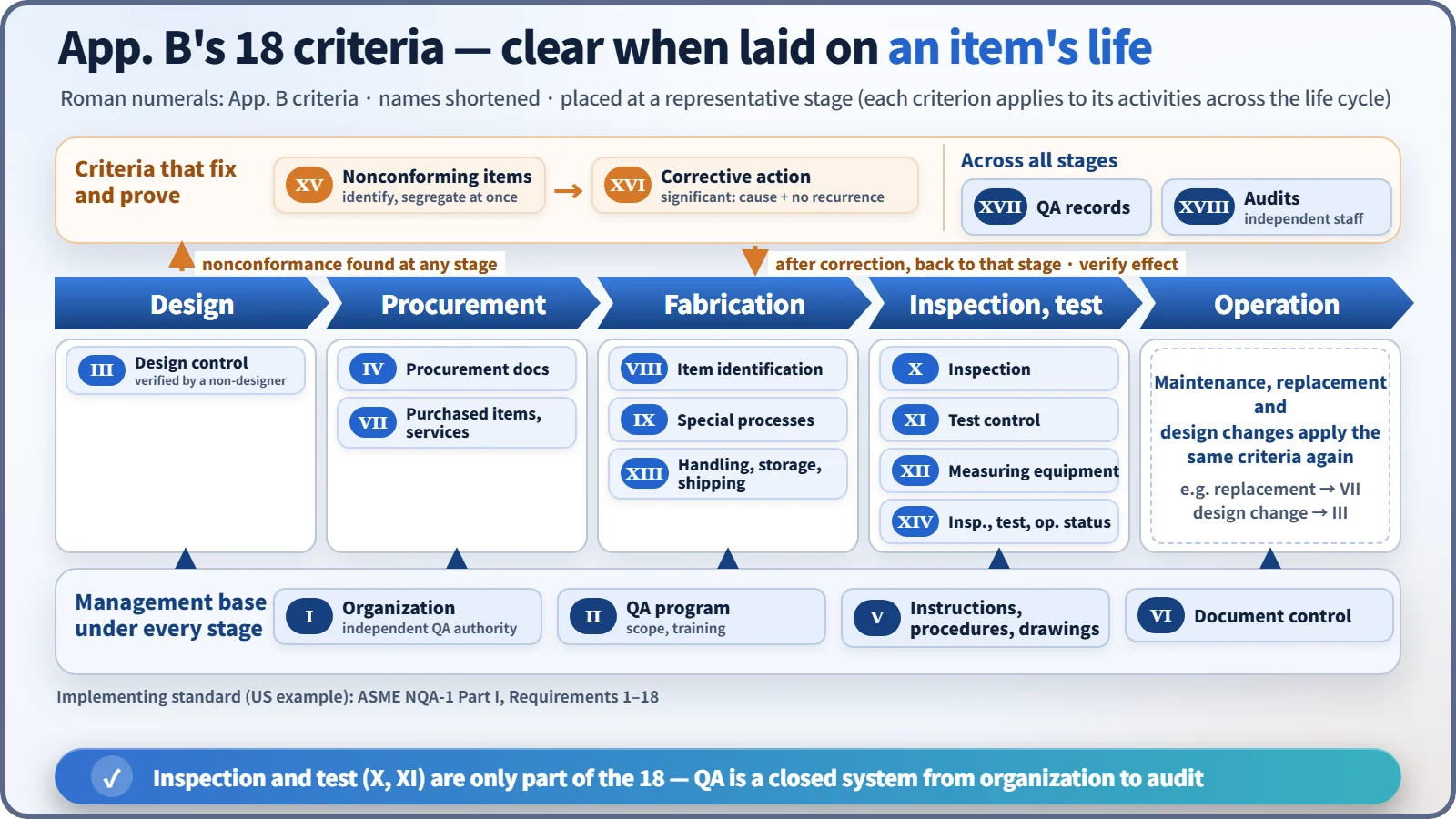
The 18 criteria of App. B (Criterion I–XVIII) state "what must be controlled." How to do it is set by the licensee in its QA manual and procedures. They are easiest to remember when laid on the flow of an item being designed, purchased, fabricated, installed and operated.
| Group | Criteria | Key requirement |
|---|---|---|
| Management base | I Organization, II Quality assurance program | The QA organization has authority independent of cost and schedule; designation of covered SSCs; training |
| Design | III Design control | Design inputs reflected, interfaces, design verification by someone other than the original designer |
| Procurement | IV Procurement document control, VII Control of purchased material, equipment and services | QA requirements in procurement documents; supplier evaluation, source inspection and receiving inspection; objective evidence that requirements are met |
| Work basis | V Instructions, procedures and drawings, VI Document control | Procedures with acceptance criteria; distribution of current revisions |
| Fabrication and construction | VIII Identification, IX Special processes, XIII Handling, storage and shipping | Traceability by heat and serial numbers; qualification of welding, heat treatment and NDE |
| Inspection and test | X Inspection, XI Test control, XII Measuring and test equipment, XIV Inspection, test and operating status | Inspectors other than those who did the work; hold points; calibration; status shown by tags |
| Fixing | XV Nonconforming items, XVI Corrective action | Identify, segregate, disposition; for significant conditions adverse to quality, determine the cause and prevent recurrence |
| Proving and checking | XVII Quality assurance records, XVIII Audits | Retrievable records; periodic audits by independent personnel, reported to management |
Three working principles
- Independence: inspections and audits are carried out by people without direct responsibility for the work. This is why Criterion I requires the QA organization to have authority free of cost and schedule pressure.
- Objective evidence: the acceptance condition is not "we made it" but "records show it was made to requirements." That is why records (XVII) and audits (XVIII) close the loop.
- Graded approach: the rigor of the requirements is matched to the safety significance of the item. Utility quality classes — safety-related (full App. B), augmented quality and general — are an example.
What it means in a plant
Supply-chain control: commercial-grade dedication and CFSI
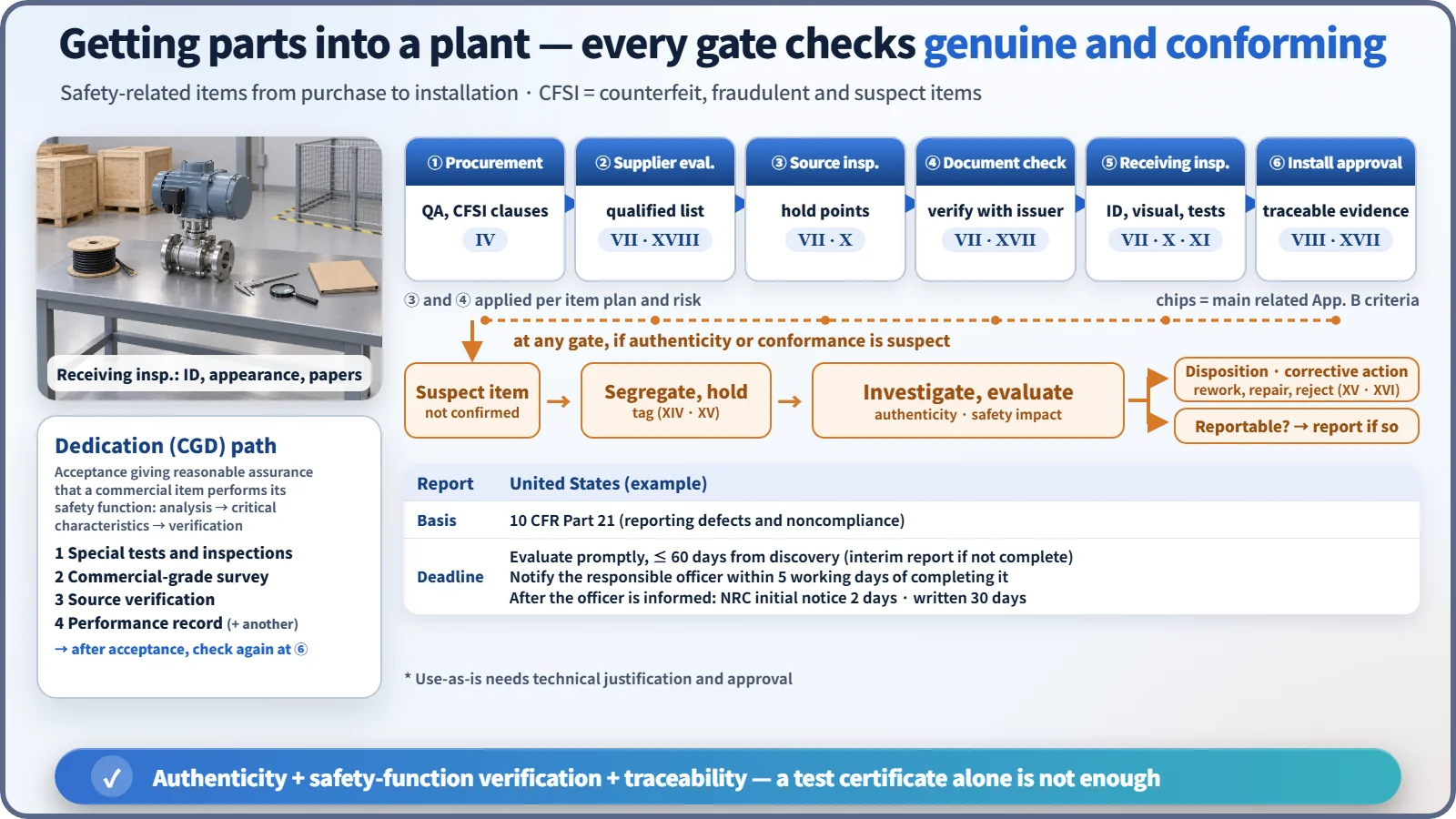
With parts becoming obsolete and suppliers dwindling, commercial items made outside an App. B program often have to be used in safety-related service. 10 CFR 21.3 defines this as commercial-grade dedication (CGD): an acceptance process in which critical characteristics are identified by safety-function analysis and verified, giving reasonable assurance that the item will perform its intended safety function. The acceptance methods are basically the four of EPRI NP-5652.
- Special tests and inspections
- Commercial-grade survey (verifying the supplier's process controls)
- Source verification (witnessing at the manufacturing site)
- Item and supplier performance record (not used alone; combined with another method)
Once dedication is complete, responsibility for Part 21 defect reporting passes to the organization that performed the dedication.
CFSI stands for counterfeit items (imitating genuine products), fraudulent items (supplied with false markings or false documents) and suspect items (showing signs of either). Substandard items are sometimes grouped with them. A suspect item is not a confirmed counterfeit, so it is segregated and held, then judged by investigation and evaluation. Even when a test certificate exists, the authenticity of that document must be checked separately: document-based acceptance (Criteria VII and XVII) presumes that the documents are genuine.
Regulatory and design criteria
The criteria below are examples from US NRC regulations and guides, the ASME consensus standard and IAEA safety standards.
| Basis | Key point |
|---|---|
| 10 CFR 50 App. B (1970) | The 18 criteria |
| RG 1.28 Rev. 6 (2023.9) | Endorses NQA-1-2017, 2019 and 2022 as methods of meeting App. B |
| ASME NQA-1 | Part I 18 requirements + Part II requirements for specific activities + appendices and guidance |
| 10 CFR 21, RG 1.164 (2017) | Defect reporting (deviation evaluation within 60 days; after the responsible officer is informed, initial NRC notification within 2 days and written report within 30 days); CGD guidance (endorsing EPRI 3002002982) |
| IAEA GSR Part 2 (2016) | Extends QA into leadership, management system and safety culture; graded approach |
Easily confused pairs
| Quality assurance (QA) | Quality control (QC) | Commercial-grade dedication (CGD) | CFSI verification | |
|---|---|---|---|---|
| Scope | Organization, design, procurement, records and audits as a whole | Inspection and testing of item characteristics | Acceptance of one commercial item | Blocking counterfeit and fraud in the supply chain |
| Question | Does the system give confidence? | Was it made to requirements? | Are the critical characteristics verified? | Are the item and its documents genuine? |
| Basis | App. B, NQA-1 | Criteria X, XI | 10 CFR 21.3, RG 1.164 | Criteria VII and XV, Part 21 |
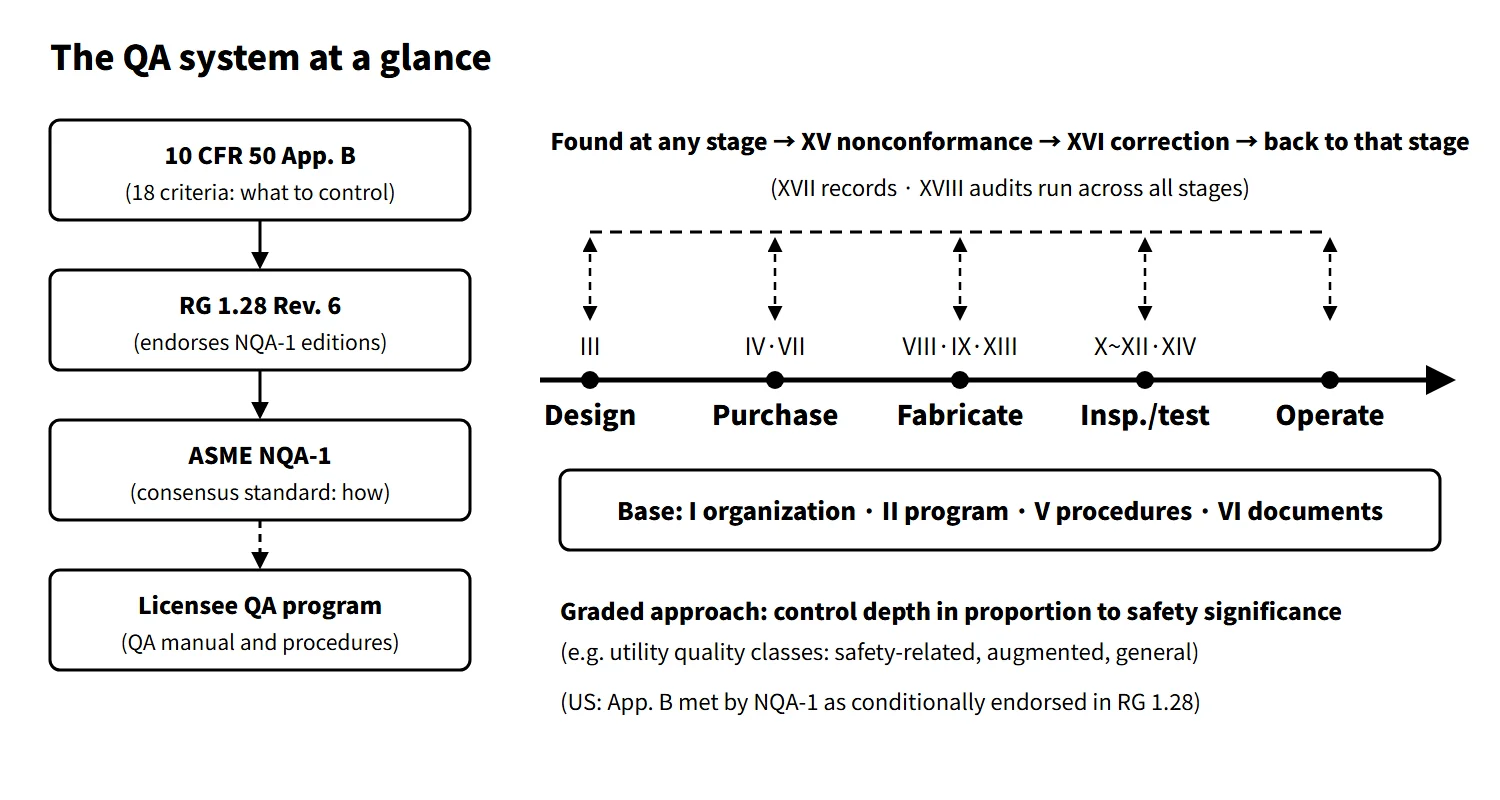
- App. B vs NQA-1: App. B is the regulatory requirement (what); NQA-1 is the consensus standard for meeting it (how). The NRC endorses specific editions through RG 1.28.
- Part 21 reporting vs nonconformance control: Part 21 requires reporting of defects and failures to comply in basic components to the regulator; Criteria XV and XVI govern how nonconforming items are identified, dispositioned and corrected within the QA program.
Key points at a glance
- Definition: all planned and systematic actions giving confidence that safety-related SSCs will perform satisfactorily (includes QC).
- Basis: for example, 10 CFR 50 App. B (US) and IAEA GSR Part 2 (management system).
- 18 criteria: (1) organization (2) QA program (3) design control (4) procurement documents (5) instructions, procedures and drawings (6) document control (7) purchased items and services (8) identification (9) special processes (10) inspection (11) test control (12) measuring and test equipment (13) handling, storage and shipping (14) inspection, test and operating status (15) nonconforming items (16) corrective action (17) QA records (18) audits.
- Principles: independence, objective evidence, graded approach.
- Standards: ASME NQA-1 (endorsed by RG 1.28 Rev. 6).
- Supply chain: CGD = verification of critical characteristics (tests, survey, source verification, performance record); CFSI = blocking counterfeit, fraudulent and suspect items, including checking the authenticity of documents.
- Scope: QA is wider than inspection — inspection and test (X, XI) are only two of the 18 criteria.