Operation, Regulation & Quality · C-OP-001
Technical Specifications (T/S) — The License Document That Turns Safety Analysis Assumptions into Operating Commitments
The license-condition document that keeps the initial conditions and equipment assumed in the safety analysis valid during operation.
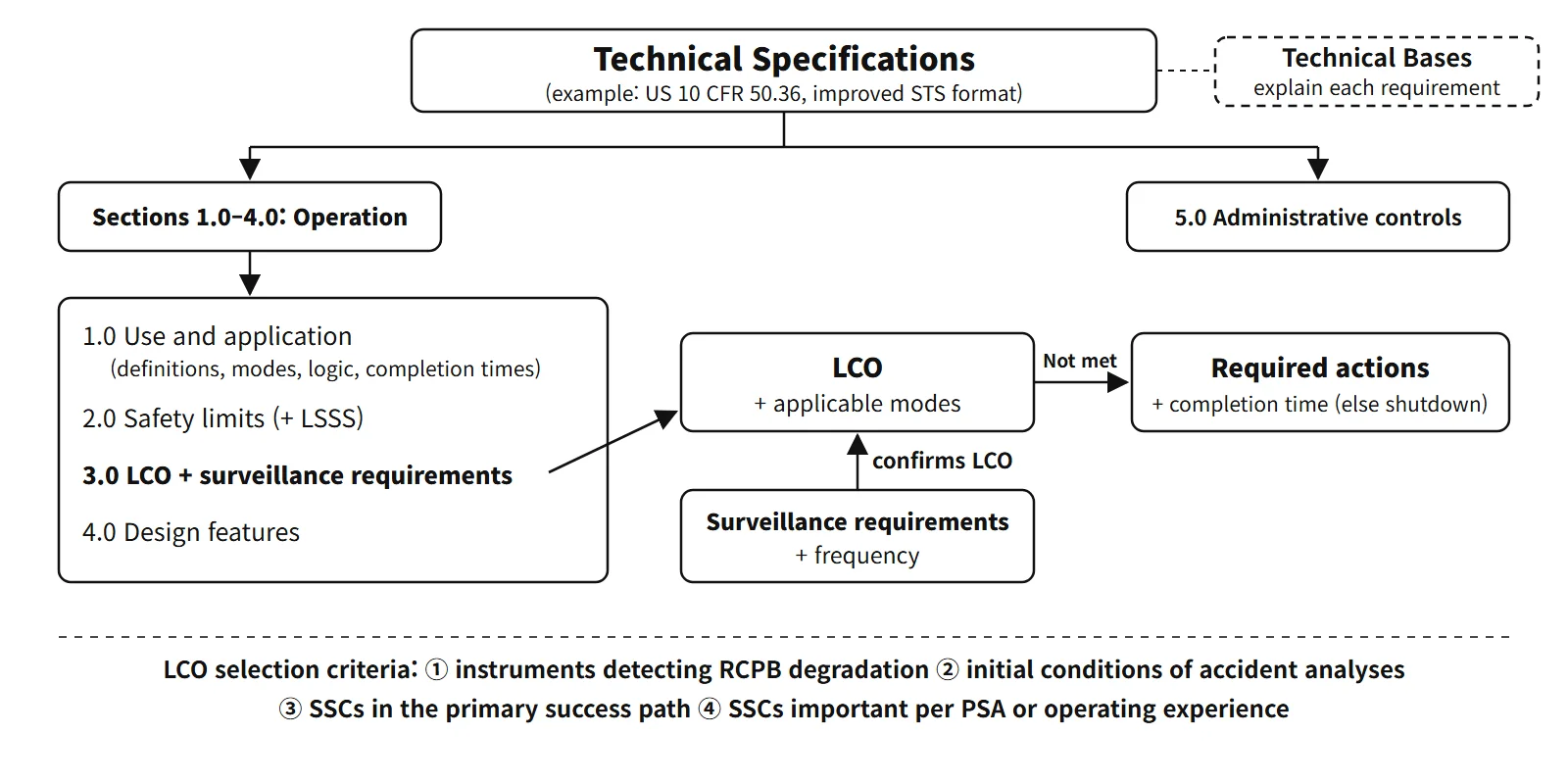
The Technical Specifications (T/S) are a license-condition document submitted with the operating license application; they set safety limits, limiting safety system settings, limiting conditions for operation, surveillance requirements, design features and administrative controls so that the process-variable limits and equipment availability assumed in the safety analysis are maintained during operation, and the licensee and its staff must comply with them.
In the United States they are required by 10 CFR 50.36; in IAEA terms they correspond to the operational limits and conditions (OLCs, SSR-2/2 Requirement 6).
Principle and mechanism
Why they are needed — the bridge between safety analysis and operation
The accident analyses in the final safety analysis report (FSAR) produce their results by assuming "what state the plant was in just before the accident" (initial conditions) and "which equipment works" (available equipment). If any of these assumptions is broken during operation, the analysis results no longer represent the plant. The Technical Specifications rewrite those assumptions as conditions the operators must maintain. That is why every specification is accompanied by Bases explaining "why this value".
Three layers: SL, LSSS and LCO
| Item | Meaning | If exceeded or not met |
|---|---|---|
| Safety limit (SL) | Limit on key process variables needed to keep the barriers against radioactive release intact | Reactor shutdown, report to the regulator, restart only after approval |
| Limiting safety system setting (LSSS) | Setpoint of automatic protective devices, chosen so that protective action occurs before the SL is reached | Reactor trip, automatic actuation of engineered safety features |
| Limiting condition for operation (LCO) | Minimum functional capability or performance level of equipment required for safe operation | Required actions within the completion time; if not, staged shutdown |
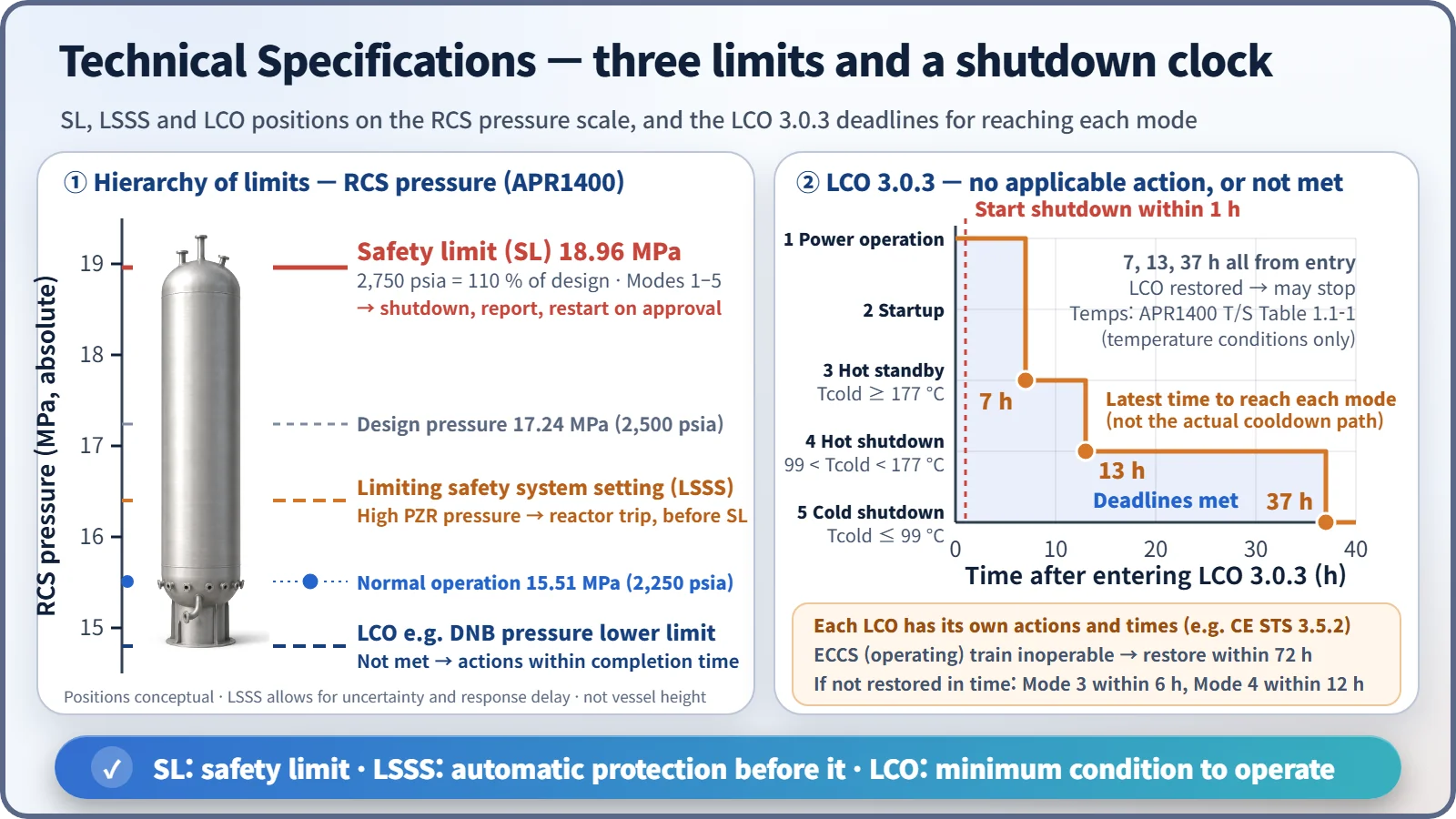
Taking RCS pressure as an example, normal operation is 15.51 MPa (2,250 psia) and the design pressure is 17.24 MPa (2,500 psia); the safety limit is 110 % of the design pressure, 18.96 MPa (2,750 psia) (APR1400, CE-type standard structure). The high pressurizer pressure trip is set between them so that, even after allowing for instrument uncertainty and response delay, the pressure turns around before the SL. On the core side, the SLs are the DNBR design limit (e.g. 1.29 for APR1400) and the peak fuel centerline temperature.
How to read one LCO
LCOs in the improved Technical Specifications are written in the same format:
- LCO statement + applicable modes: what must be operable in which modes
- ACTIONS: condition – required action – completion time, joined by the logical connectors AND/OR.
- Surveillance requirement (SR) + frequency: tests, calibrations and inspections that confirm the LCO is met. If a surveillance is not performed or is not satisfied, the LCO is considered not met (SR 3.0.1). The frequency may be extended up to 1.25 times (SR 3.0.2).
If no action applies, or the actions cannot be carried out, LCO 3.0.3 applies: from entry, shutdown action must start within 1 hour, reaching Mode 3 within 7 hours, Mode 4 within 13 hours and Mode 5 within 37 hours. These times are deadlines counted from entry, not cumulative. If the LCO is restored along the way, the shutdown may be stopped.
Operability
Every T/S judgement starts from "is it operable?". A system, train or component is operable when it can perform its specified safety function and the support functions it needs — instrumentation and controls, normal or Class 1E power, cooling and seal water, lubrication — are also available. When a deficiency is found, an immediate determination is made without delay from the available information, followed if necessary by a prompt determination with additional analysis. A condition that is operable but degraded is tracked through corrective action. The linkage by which a support system being inoperable makes the supported systems inoperable is set by the safety function determination program.
What it means in a plant
- Operation: the applicable LCOs change with the operating mode (1 power operation to 6 refueling). In the APR1400 example, Mode 3 is Tcold ≥ 177 °C and Mode 5 is Tcold ≤ 99 °C.
- Maintenance: the completion time is a margin for restoring a failure once it is found. When equipment is deliberately made inoperable for planned maintenance, this is managed together with a risk assessment.
- Design and licensing: values used as initial conditions in the safety analysis (shutdown margin, SIT pressure and level, power distribution limits) become LCOs as they are. Shutdown margin is defined assuming that the single control rod of highest reactivity worth is stuck.
- Leakage control: coolant leakage is divided into identified, unidentified and pressure boundary leakage, each with its own limit. Pressure boundary leakage is not allowed.
Regulatory and design criteria
The references below are examples from the United States (US NRC) and the IAEA.
| Basis | Key point |
|---|---|
| 10 CFR 50.36(c) | (1) SL and LSSS (2) LCOs and selection criteria (3) SRs (4) design features (5) administrative controls |
| NUREG-1431 (W) and 1432 (CE) | Improved Standard Technical Specifications (ISTS). The APR1400 T/S are based on NUREG-1432 |
| IAEA SSR-2/2 Rev. 1, SSG-70 | Operational limits and conditions (OLCs) |
The four LCO selection criteria (as codified in 10 CFR 50.36(c)(2)) are:
- Instrumentation installed in the main control room to detect and indicate significant abnormal degradation of the reactor coolant pressure boundary
- Process variables, design features or operating restrictions that are initial conditions of design basis accident and transient analyses assuming failure of or a challenge to a fission product barrier
- Structures, systems and components (SSCs) that are part of the primary success path that mitigates such accidents and transients
- SSCs shown by operating experience or PSA to be significant to public health and safety
History of revisions: the United States codified these four criteria through the 1993 policy statement and the 1995 revision of 10 CFR 50.36, and issued the Improved Standard Technical Specifications reflecting them (ISTS, NUREG-1430 to 1434). Items that do not meet the criteria were moved (relocated) to licensee-controlled documents such as the FSAR and programs, and the Bases and the LCO 3.0/SR 3.0 general rules were reorganized.
Easily confused pairs
| Technical Specifications (T/S) | Operating procedures | Bases | FSAR | |
|---|---|---|---|---|
| Nature | License conditions (what must be kept) | How to do it | Rationale for each T/S provision | Entire design and safety analysis |
| Changes | License amendment (minor items by notification) | Licensee internal control | Managed together with the T/S | License amendment or notification |
| If violated | Violation of law, shutdown and report | Internal action | — | — |
The SL and the LCO are also often mixed up. Exceeding an SL leads to shutdown, reporting and restart only on approval; an LCO not being met is an allowed condition managed through the required actions.
Key points at a glance
- Definition: operating-license condition document that keeps the safety analysis assumptions (initial conditions, available equipment) valid during operation; the licensee must comply.
- Basis (examples): US 10 CFR 50.36 and NUREG-1431/1432 (ISTS); IAEA SSR-2/2 operational limits and conditions.
- Structure (ISTS format): 1.0 use and application → 2.0 safety limits (+ LSSS) → 3.0 LCOs and surveillance requirements → 4.0 design features → 5.0 administrative controls, plus Bases.
- SL: process-variable limits protecting the barriers; exceeding one means shutdown, report and restart on approval (e.g. RCS pressure 18.96 MPa).
- LCO: minimum function and performance; applicable modes + required actions + completion time.
- Selection criteria: ① instruments detecting RCPB degradation ② accident-analysis initial conditions ③ primary success path SSCs ④ PSA and operating experience.
- General rules: operability (including support functions), LCO 3.0.3 (1, 7, 13, 37 h), SR frequency extension up to 1.25 times.
- ISTS: LCOs sorted by the four criteria, non-qualifying items relocated, Bases expanded.