Fuel & Materials · C-FM-007
U-235 Consumption and Enrichment Change — Fissions, Capture (α) and Remaining Enrichment in One Calculation
From thermal power to fissions, from fissions to U-235 consumed with capture, and from there to the remaining enrichment, with worked examples.
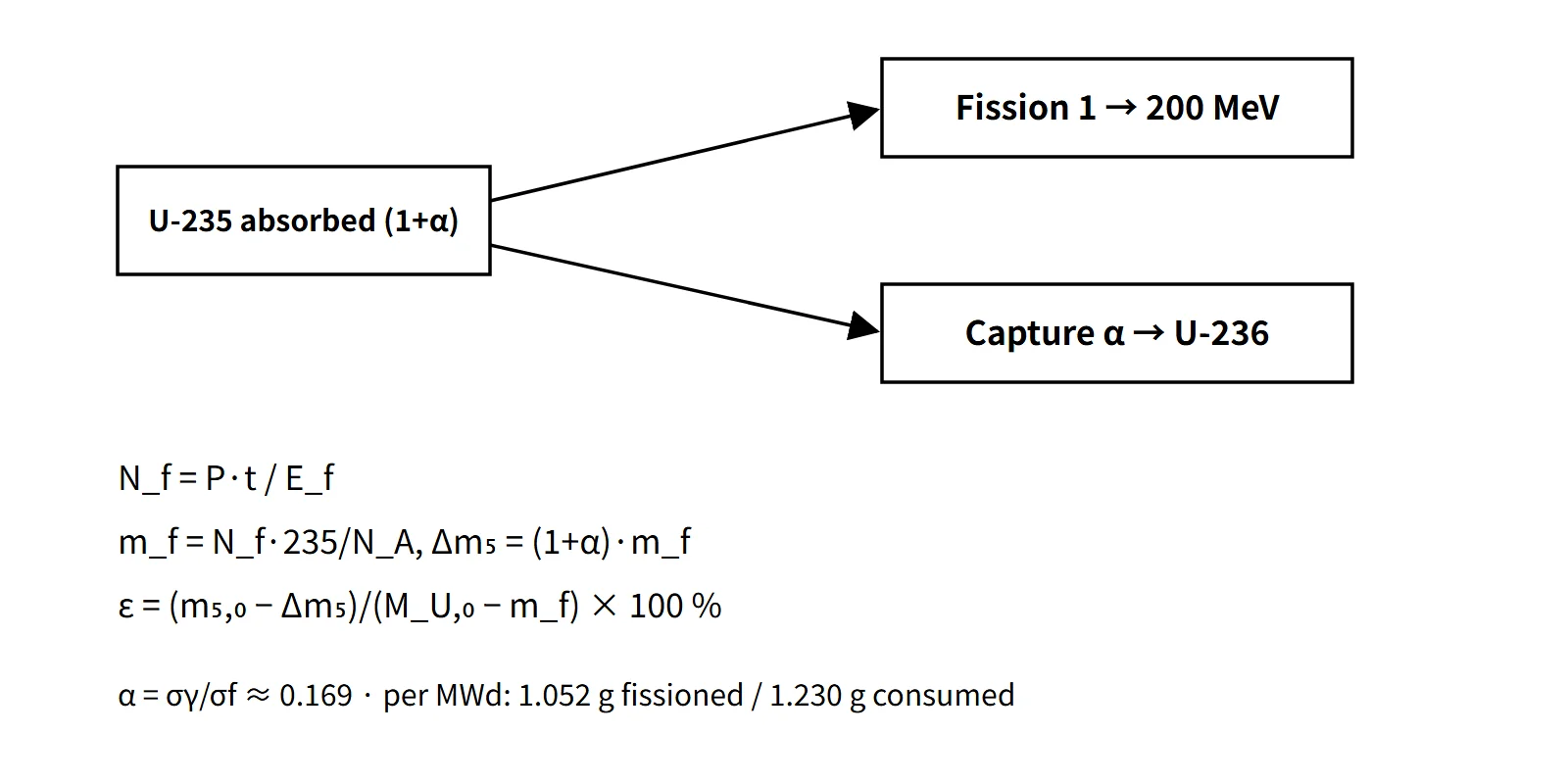
U-235 consumption is the amount of U-235 lost by neutron absorption, the sum of fissions and radiative captures: consumption = fissioned amount × (1 + α), with α = σγ/σf ≈ 0.169; the enrichment after burnup is the remaining U-235 mass divided by the remaining U mass.
Principle and mechanism
Starting point — from thermal power to fission rate
- The recoverable energy per fission is Ef ≈ 200 MeV = 3.204×10⁻¹¹ J.
- Fission rate Rf = P / Ef → 1 W ≈ 3.12×10¹⁰ fissions/s. A rounded conversion factor of 3.1×10¹⁰ fissions/W·s corresponds to about 201 MeV per fission.
- 1 MWd = 8.64×10¹⁰ J ≈ 2.70×10²¹ fissions → mass of U-235 fissioned = 2.70×10²¹ × 235.04 / 6.022×10²³ ≈ 1.05 g/MWd.
This note carries the same constants (200 MeV, 1.05 g/MWd, 0.8815) throughout.
Absorption = fission + capture
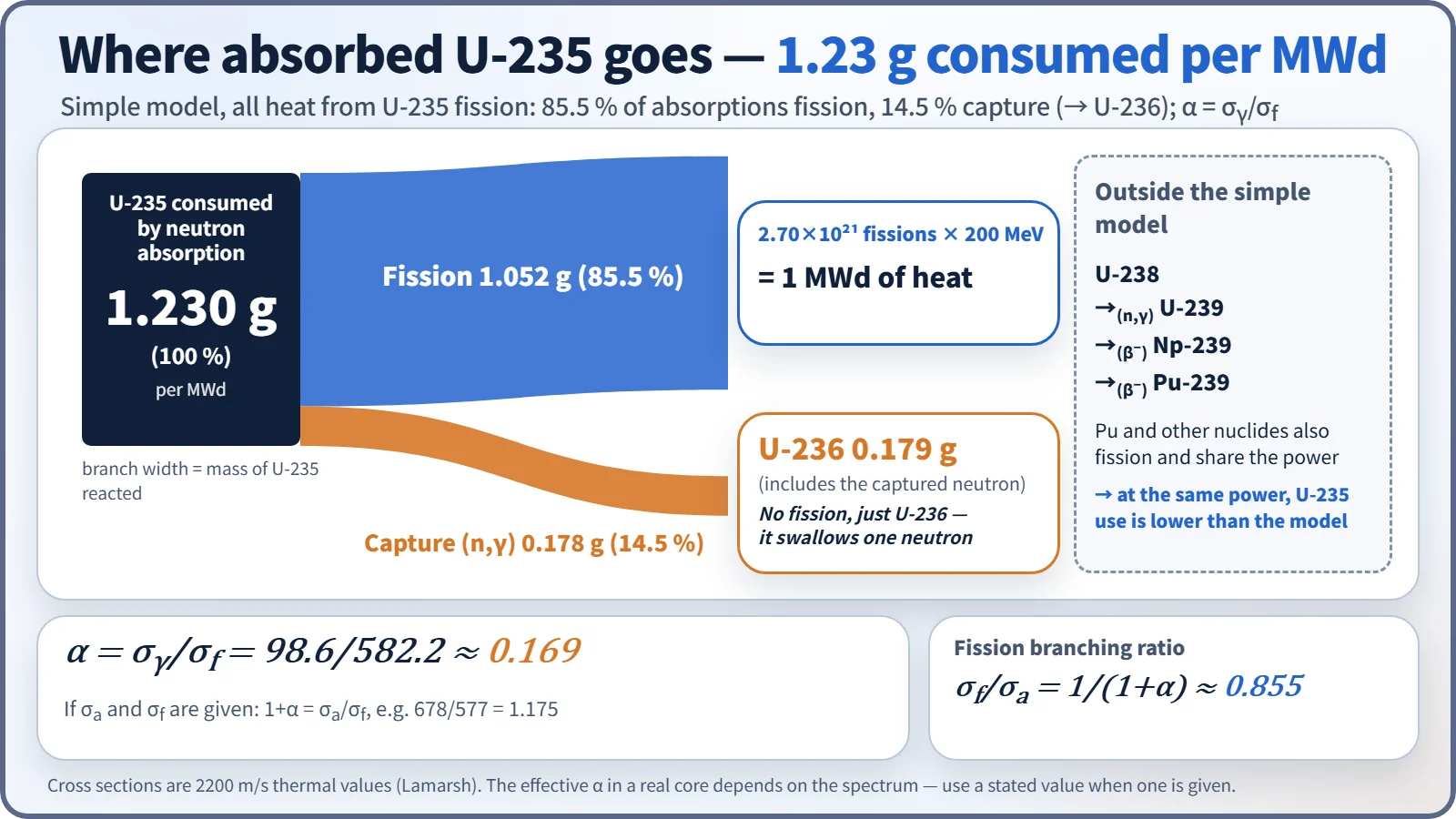
Not every thermal neutron absorbed by U-235 causes fission. Some are radiative captures (n,γ) that produce U-236, which does not fission with thermal neutrons and acts only as a parasitic absorber.
| Quantity | Definition | 2200 m/s value (textbook) |
|---|---|---|
| α | σγ / σf | 98.6 / 582.2 = 0.169 |
| Fission probability per absorption | σf / σa = 1/(1+α) | 0.855 |
| η | ν / (1+α) | 2.43 / 1.169 = 2.08 |
So per MWd, consumption = 1.052 × 1.169 ≈ 1.23 g, and the 0.178 g captured becomes 0.179 g of U-236 (heavier by the neutron mass). Radiative capture also releases gamma energy, but it is small compared with fission energy and already partly included in Ef (200 MeV). If σa and σf are given instead, 1+α = σa/σf (for example 678/577 = 1.175).
How enrichment falls
The calculation has three steps.
- Nf = Pth·t / Ef (number of fissions; Pth is thermal power, t = capacity factor × operating days)
- mf = Nf × 235/NA, Δm₅ = (1+α)·mf (without α, Δm₅ = mf)
- ε = (m₅,₀ − Δm₅) / (MU,0 − mf) × 100 % — the denominator is the remaining U, i.e. the initial U minus only the fissioned mass (captured U-235 stays as U-236, so it is not subtracted)
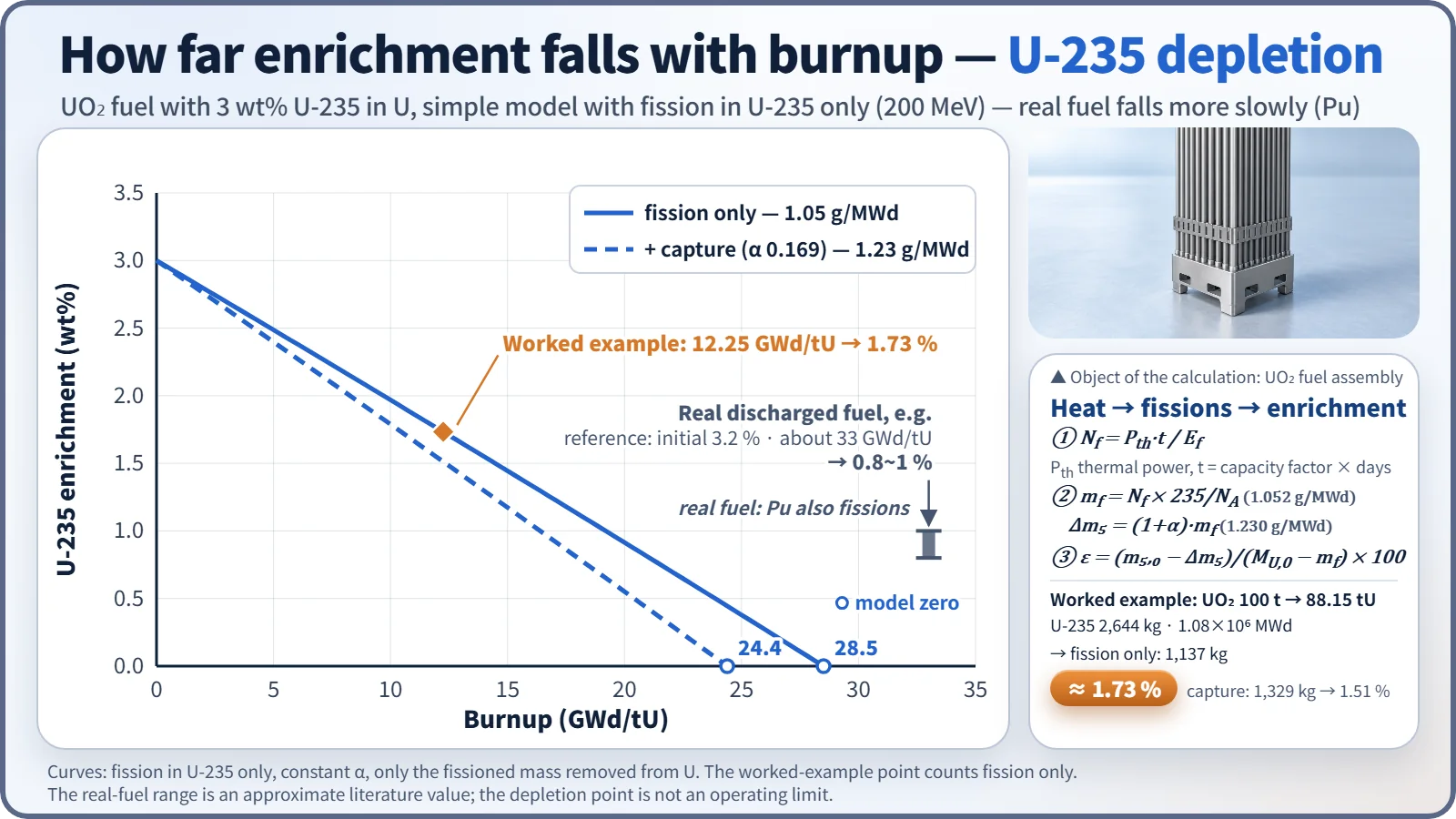
Worked example: 100 t of 3 % UO₂, 4,000 MWt, 90 % capacity factor, 300 days.
- MU = 100 × 0.8815 = 88.15 tU; initial U-235 = 2,644 kg
- Energy released 1.08×10⁶ MWd → burnup 12,252 MWd/tU
- U-235 fissioned = 1.08×10⁶ × 1.052 g = 1,137 kg
- Remaining 1,508 kg ÷ (88,147 − 1,137) kg = 1.73 %
- Including capture with α = 0.169: consumption 1,329 kg, enrichment 1.51 %
Two shorter worked results at 200 MeV per fission:
- 1,000 MWt for one day: 2.70×10²⁴ fissions, 1.05 kg of U-235 fissioned, 1.23 kg consumed
- Fissioning all of 1 g of U-235 releases about 5.12×10²³ MeV; a 3,000 MWt core fissions about 3.16 kg of U-235 per day
In this simple model 3 % fuel runs out of U-235 at about 28.5 GWd/tU counting fission only, or about 24.4 GWd/tU including capture. Real PWR fuel, however, burns much longer, because other nuclides such as Pu-239 bred from U-238 capture also contribute to fission (the Pu share is around half at end of cycle); fuel with an initial 3.2 % discharged at about 33 GWd/tU is known to retain roughly 0.8–1 % U-235 (an approximate value common in the literature).
What it means in a plant
- Core design: cycle length is set by the balance between the fissile inventory and the build-up of poisons. When choosing the initial enrichment and loading, U-235 depletion and Pu production are tracked with depletion codes.
- Reactivity management: U-235 depletion and the build-up of U-236 and fission products reduce the excess reactivity, which PWRs compensate by lowering the boron concentration. The parasitic absorption of U-236 is a reactivity penalty when reprocessed uranium is reused.
- Kinetics: as the Pu-239 share grows toward end of life, βeff decreases.
- Nuclear material accountancy: the U-235 and Pu inventories of spent fuel are calculated with depletion codes and used for accountancy and safeguards declarations.
- Reactor type examples: fresh OPR1000 and APR1400 fuel is low-enriched below 5 wt% (example), while CANDU uses natural U (0.711 %) and has a low discharge burnup of about 7 GWd/tU (example).
Regulatory and design criteria
The items below are examples: US NRC rules and guidance, and the general definition of low-enriched uranium.
| Basis | Key point |
|---|---|
| 10 CFR 50.68(b)(7) | Nominal enrichment of fresh fuel assemblies 5.0 wt% U-235 or less (condition for the 50.68 criticality alternative). Higher enrichment needs an exemption — 2023 exemption for 6 wt% lead test assemblies at Vogtle Unit 2 |
| RG 1.183 Rev. 1 (2023) | Extends the applicability of accident source-term release fractions to 8 wt% enrichment and a rod-average 68 GWd/MTU |
| Low-enriched uranium (LEU) | Less than 20 % U-235 |
Fuel enrichment is moving beyond the 5 wt% limit toward LEU+ (5–10 %).
Easily confused pairs
| Fissioned amount | Consumption (absorption) | Depletion | Enrichment | |
|---|---|---|---|---|
| Definition | U-235 that fissioned | Fission + capture | Process of enrichment falling with burnup | Raising the U-235 fraction by isotope separation |
| Per MWd | 1.05 g | 1.23 g (α 0.169) | — | — |
| Basis of calculation | P·t / Ef | × (1+α) | ε = remaining U-235 / remaining U | Mass balance and SWU |
| Common mistake | Confusing it with consumption | Omitting α (about 15 % too low) | Not converting UO₂ to U | Confusing it with depletion |
Not converting UO₂ to U changes the result considerably: in one worked case the remaining enrichment is 0.74 % with the conversion and 1.01 % without it.
Key points at a glance
- Definition: U-235 consumption = neutron absorptions = fissions + radiative captures (→ U-236).
- Fission rate: Rf = P/Ef; 1 W ≈ 3.1×10¹⁰ fissions/s; 1 MWd ≈ 2.7×10²¹ fissions.
- Fissioned amount: 1 MWd ≈ 1.05 g of U-235 (fissioning all of 1 g ≈ 5.12×10²³ MeV ≈ 0.95 MWd).
- α: σγ/σf ≈ 0.169 → consumption = fissions × 1.169 ≈ 1.23 g/MWd.
- U-236: fissioned amount × α ≈ 0.18 g/MWd, a parasitic absorber.
- Enrichment: ε = (m₅,₀ − Δm₅)/(MU,0 − mf) × 100 %, with MU,0 = MUO₂ × 0.8815 (check whether a mass is given as U or as UO₂).
- Example: 3 % UO₂ 100 t, 1.08×10⁶ MWd → 1,137 kg fissioned, 1.73 %.
- Limits: ignoring Pu-239 and U-238 fast fission → the real decrease is slower; precise values need depletion calculations.
- Regulation: 5 wt% limit for fresh fuel (10 CFR 50.68), inventory calculation for accountancy.